English (India)
 Español
 Português
 Français
 Deutsch
 Italiano
 العربية
Enter the 9-digit routing number from the bottom left of a check or from your bank’s website. The validator checks the Federal Reserve district prefix and the check digit, and splits the number into its parts. Nothing you type leaves your browser.
How to use the routing number validator
Type or paste the nine digits. Spaces and dashes are ignored. The validator runs three checks and shows a pass or fail for each:
- Length: exactly nine digits.
- Prefix: the first two digits fall in one of the ranges the Federal Reserve uses.
- Check digit: the ninth digit matches the value calculated from the first eight.
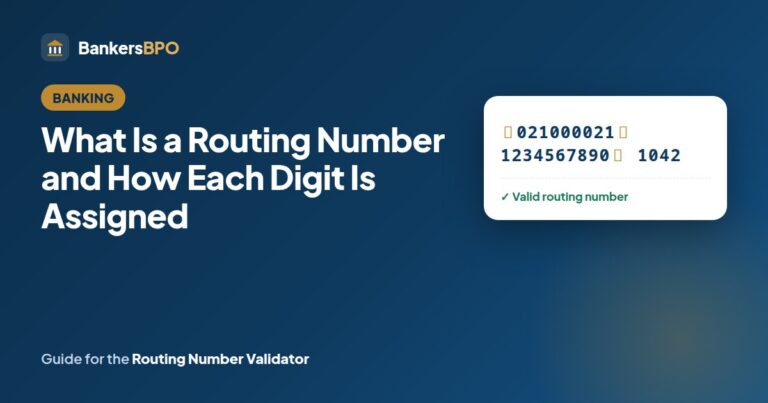
Below the checks it splits the number into the Federal Reserve routing symbol (digits 1 to 4), the ABA institution identifier (digits 5 to 8) and the check digit (digit 9).
Where to find your routing number
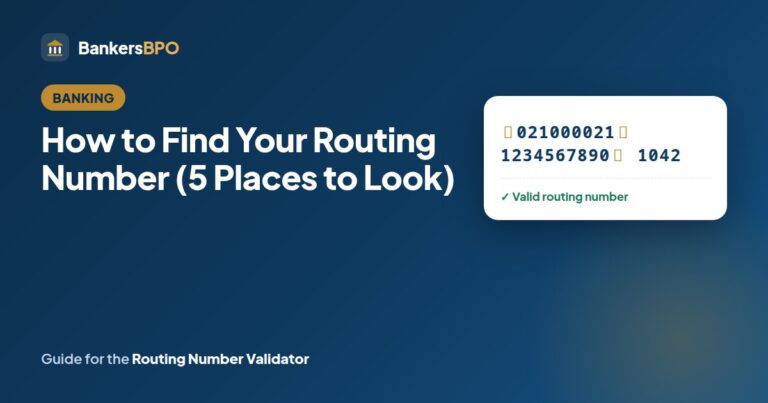
- On a paper check, it is the first group of nine digits along the bottom, between the ⑆ symbols. The account number and check number follow it.
- In your online banking or app, usually under account details or direct deposit information.
- On your bank’s website, often on a page listing routing numbers by state, since large banks use different numbers in different regions.
- On a direct deposit form, which many banks let you download already filled in.
Deposit slips sometimes carry a different internal routing number. Use the one from a check or from the bank.
What the parts mean
| Digits | Name | Meaning |
|---|---|---|
| 1 and 2 | Federal Reserve district code | 01 to 12 for the twelve Federal Reserve districts, 00 for the US government, 21 to 32 for thrift institutions, 61 to 72 for electronic transactions, 80 for traveler’s checks |
| 3 and 4 | Federal Reserve office | The processing center or office within the district |
| 5 to 8 | ABA institution identifier | The specific bank or credit union |
| 9 | Check digit | Calculated from the first eight digits to catch typos |
The first digit pairs map to the twelve Federal Reserve districts: 01 Boston, 02 New York, 03 Philadelphia, 04 Cleveland, 05 Richmond, 06 Atlanta, 07 Chicago, 08 St. Louis, 09 Minneapolis, 10 Kansas City, 11 Dallas and 12 San Francisco. Thrift institutions use the same districts plus 20, so 21 is Boston, 22 New York, and so on.
How the check digit works
The validator multiplies the nine digits by the weights 3, 7, 1, 3, 7, 1, 3, 7, 1 and adds the results. If the total is a multiple of 10, the check digit is correct.
Example with 021000021, a published JPMorgan Chase routing number for New York:
- 0×3 + 2×7 + 1×1 = 15
- 0×3 + 0×7 + 0×1 = 0
- 0×3 + 2×7 + 1×1 = 15
- Total: 30, which is divisible by 10, so the number passes.
Change any single digit and the total stops being a multiple of 10, so the check catches every one-digit typo. It also catches most cases where two neighboring digits are swapped, which is the other common mistake when copying numbers by hand.
Why a routing number fails
- Wrong length. Eight digits usually means a leading zero was lost in a spreadsheet, because many routing numbers start with 0. Ten or more usually means part of the account number or check number was copied along with it.
- Wrong prefix. A number starting with 13 to 20, 33 to 60, 73 to 79 or 81 and above is not a routing number. It is often an account number pasted into the wrong field.
- Wrong check digit. One digit was mistyped or misread. Common culprits on handwritten forms are 1 and 7, 3 and 8, and 5 and 6. Go back to the source rather than trying to guess which digit is wrong.
If the number comes from a check, read it from the printed line at the bottom, not from a handwritten form. The magnetic ink line is the version the banks themselves process.
What a pass does and does not prove
A pass means the number is well formed: right length, possible prefix, correct check digit. It does not prove that:
- the number is currently assigned to a bank, because banks merge and retire routing numbers,
- it belongs to the bank you think it does,
- it is the right number for the kind of payment you are making.
The last point catches people out. Many banks use one routing number for ACH payments such as direct deposit and bill pay and a different one for wire transfers. Some large banks also use different ACH numbers by the state where the account was opened. Before a large transfer, confirm the number with the bank.
To look up which bank a routing number belongs to, use the American Bankers Association’s routing number lookup, or the Federal Reserve’s E-Payments Routing Directory for ACH and Fedwire participants.
ACH versus wire routing numbers
- ACH payments, which include direct deposit, payroll, Social Security payments and most bill pay, use the ACH routing number. This is usually the one printed on your checks.
- Domestic wire transfers through Fedwire may need a separate wire routing number. Your bank’s wire instructions will state it.
- International wires into a US account use a SWIFT/BIC code for the bank, and often a US intermediary bank’s details. The ABA routing number may be asked for as well, but it is not enough on its own.
If you give an employer or a payment app the wire number when it asked for the ACH number, the payment may be rejected or delayed. If you are not sure which one you have, ask the bank.
When the validator helps
- Setting up direct deposit with a new employer, to catch a typo before the first payday.
- Adding a vendor or contractor for ACH payments in accounting or payroll software.
- Checking bank details that arrived by email. A routing number that fails the check is a red flag, and even one that passes should be confirmed by phone if the email asked you to change payment details, which is a common fraud pattern.
- Reviewing a check before mobile deposit or before paying someone.
For the rest of the paperwork, the EIN validator checks a vendor’s tax ID and the check amount in words converter writes out the legal amount for a check. If a payment includes tax, the sales tax calculator works out the total.
Account numbers
The validator checks routing numbers only. US account numbers have no standard length or check digit. They can be anywhere from about 4 to 17 digits, and each bank sets its own format. Copy the account number from a check or the bank’s documents and read it back digit by digit.
A simple habit avoids most payment errors: when you add new bank details, run the routing number through the validator, then send a small test payment before the first large one. Most payroll and accounting systems support a small test deposit for this purpose.
Privacy
The checks run in your browser. Routing numbers are not sent to our server or stored.
Learn more
What is a routing number explains the parts and the check digit. How to find your routing number lists where it appears and the ACH-versus-wire catch.
Frequently asked questions
Is a routing number the same as an ABA number?
Yes. Routing number, routing transit number (RTN) and ABA number all mean the same nine-digit code. The American Bankers Association created the system in 1910 and still manages the assignment of numbers. A SWIFT or BIC code is something different, used for international transfers.
Why does my bank have more than one routing number?
Large banks often have several, either because of mergers or because they assign numbers by the state where you opened the account. Many also use a separate number for wire transfers. Use the number printed on your checks or shown in your online banking for that specific account.
Can a routing number pass the check and still be wrong?
Yes. The check digit catches typos in a single digit and most swaps of neighboring digits, but a number with several errors can still pass by chance, and a valid number can belong to a different bank. Confirm the bank name with the ABA lookup or the bank itself before a large payment.
Is it safe to share my routing number?
Your routing number identifies your bank, not your account, and it is printed on every check you write, so it is not secret. Your account number is more sensitive, but both are needed to set up direct deposit or ACH payments. Share them only with people and companies you are paying or being paid by.
What routing number do I use for a wire transfer?
Use the wire routing number from your bank’s wire instructions, which may differ from the one on your checks. For incoming international wires, the sender will also need your bank’s SWIFT code. Call the bank or check its website, because wire mistakes are much harder to reverse than ACH errors.
Does a routing number tell you which state the bank is in?
It tells you the Federal Reserve district that processes it, which covers several states. A 12 prefix, for example, is the San Francisco district, which includes California and eight other western states. Because of mergers, the routing number may also point to where an account was first opened rather than where the bank is based now.