 English (India)
 Español
 Português
 Français
 Deutsch
 Italiano
 العربية
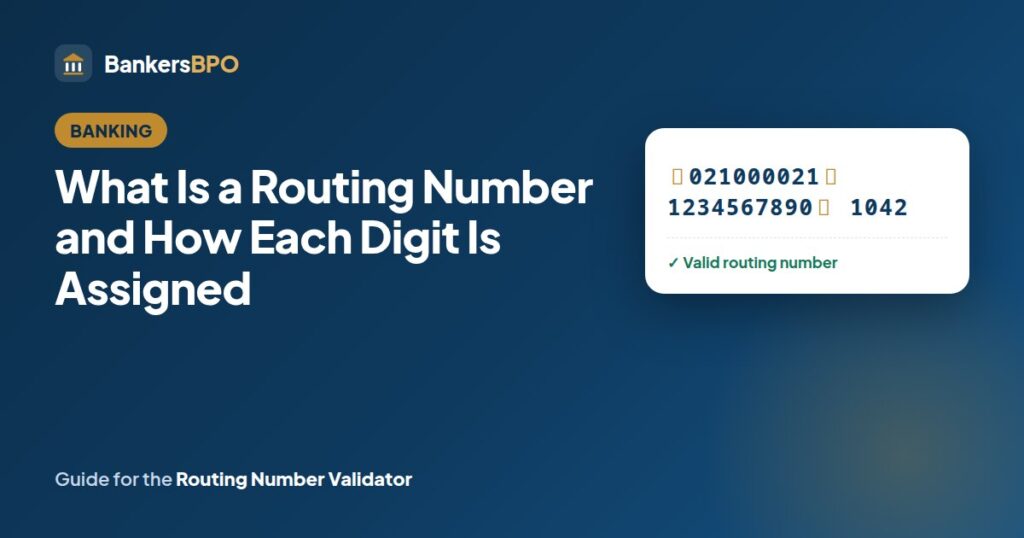
Every check, direct deposit form and wire instruction in the United States carries a nine-digit number that identifies the bank, and almost nobody knows what the digits mean. Here is what is a routing number, how the American Bankers Association assigns each part, how the last digit catches typos, and why your bank may have more than one. The routing number validator runs the check-digit test on any number you enter; this guide explains what it is testing.
The number in one sentence
A routing transit number (RTN), also called an ABA number, is a nine-digit code that identifies a US bank or credit union for the purpose of moving money: paying checks, ACH transfers such as direct deposit and bill pay, and domestic wires. It was created in 1910 by the American Bankers Association and is now administered by Accuity (part of LexisNexis) on the ABA’s behalf. Each number belongs to one institution; large banks hold many.
The three parts
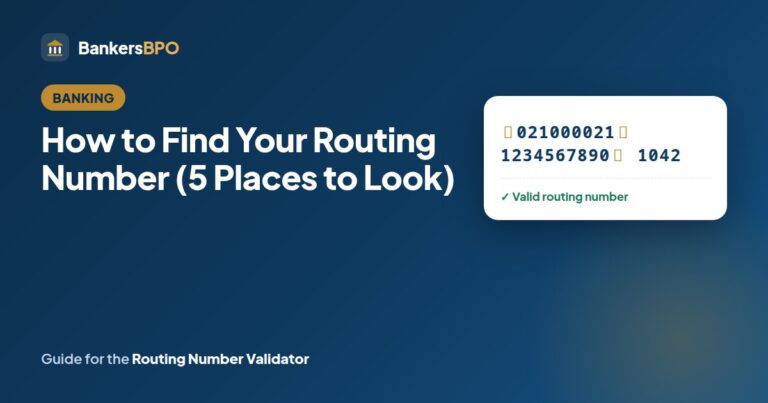
Take 021000021, the routing number on many JPMorgan Chase checks from New York.
| Digits | Value | Meaning |
|---|---|---|
| 1 to 4 | 0210 | Federal Reserve routing symbol |
| 5 to 8 | 0002 | ABA institution identifier |
| 9 | 1 | Check digit |
The first two digits give the Federal Reserve district and the type of institution. 01 to 12 are the twelve Federal Reserve districts (01 Boston, 02 New York, 03 Philadelphia, through 12 San Francisco) for ordinary banks. 21 to 32 are the same districts for thrift institutions, 61 to 72 for electronic transaction identifiers, and 80 for traveler’s checks. Anything else, such as a number starting with 13 to 20 or above 80, is not a valid routing number. So 02 in the example means the Second District, New York.
Digits three and four refine the location within the district: the Fed office or check-processing region. Digits five to eight identify the particular bank, assigned in sequence by the ABA registrar. The ninth is the check digit.
The check digit
The ninth digit is computed from the first eight with a weighted sum, so that a single mistyped digit or most transposed pairs produce a number that fails the test. The rule: multiply the digits by the weights 3, 7, 1, 3, 7, 1, 3, 7, 1 in order, add them up, and the total must be divisible by 10.
For 021000021: 3×0 + 7×2 + 1×1 + 3×0 + 7×0 + 1×0 + 3×0 + 7×2 + 1×1 = 0 + 14 + 1 + 0 + 0 + 0 + 0 + 14 + 1 = 30. Divisible by 10, so the number is well formed.
Change the last digit to 2 and the sum is 31, which fails. Swap the 2 and 1 in positions eight and nine (…012) and the sum is 3×0 + 7×1 + 1×2 = 9 for that group instead of 15, total 24, which also fails. The test catches every single-digit error and most adjacent transpositions, which is why a bank’s online form rejects a mistyped routing number instantly without looking anything up.
The routing number validator applies exactly this formula, checks that the first two digits are in a valid range, and splits the number into its three parts.
Why one bank has many routing numbers
Banks that grew by merger kept the routing numbers of the banks they absorbed, so a national bank may have one number for accounts opened in Texas and another for Ohio. The number on your checks is the one tied to the state or legacy bank where the account was opened, and it is the one to use for ACH. Some banks also publish a separate routing number for wires, usually the number of their main office, and using the ACH number on a wire form can delay the transfer. Your bank’s website lists both; the how to find your routing number guide covers where to look.
A short history, because it explains the oddities
The ABA created the numbering system in 1910 so that checks could be sorted by hand to the right bank. The original form was a fraction printed in the top right of the check: the city or state code over the bank number, with the Federal Reserve routing symbol below. When magnetic ink encoding arrived in the 1950s, the fraction was flattened into the nine-digit MICR line, and the fraction itself survives on many checks today as a small number in the upper right, such as 1-2/210, which is the same information in the old format. The two-digit district prefixes, the separate 21 to 32 range for thrifts (a legacy of when savings and loans cleared separately) and the 61 to 72 range for electronic-only identifiers all date from decisions made for paper sorting, and the system has never been renumbered because too many checks, forms and databases depend on it. New numbers are still issued every week as banks are chartered or merged, always within the same ranges, and retired numbers are kept out of circulation for years so that old checks do not land at the wrong bank.
Where the number appears
On the bottom left of a check, printed in magnetic ink (MICR) between two colon-like symbols, followed by the account number and the check number. On the bank’s website and app, usually under account details. On direct deposit and ACH forms, which ask for it alongside the account number. The validator does not need your account number; the routing number alone is public information and identifies only the bank.
ACH, wire and SWIFT
An ACH transfer (direct deposit, automatic bill pay, most app-to-bank transfers) uses the ABA routing number and settles in one to two business days through the Automated Clearing House network. A domestic wire uses the Fedwire system, also addressed by routing number, and settles the same day for a fee. An international transfer uses a SWIFT/BIC code, an eight- or eleven-character code such as CHASUS33, instead of a routing number; many banks also want their routing number included for the final leg into the US account. The validator checks ABA numbers only; the IBAN tool on the other-language versions of this site checks European and Gulf account numbers.
Routing numbers and fraud
Because routing numbers are public, they are not a secret, and knowing one lets no one take money from you. The account number is the sensitive part, and even that is printed on every check you write. The common frauds are different: a fake invoice with changed routing and account numbers, so a payment goes to the fraudster’s account at a real bank; or a phishing message asking you to “confirm” your account number. Validate the routing number, then call the payee at a number you already have to confirm the account before changing payment details.
Checking a number
Enter the nine digits in the routing number validator. A pass means the number is well formed and the district is valid; it does not mean the account exists or that the number is the right one for a wire. For a vendor set-up, pair it with an EIN validator check on their tax ID, and for the amount on the check, the check amount in words tool. All the tools are on the homepage.
FAQs
Is the routing number the same as the account number?
No. The routing number identifies the bank and is the same for every customer whose account was opened in that region. The account number identifies your account within the bank. Both are needed to send money to you; only the account number is private.
Do credit unions have routing numbers?
Yes. Credit unions use the same ABA system, and many small ones use a corporate credit union’s routing number with the member’s account number identifying the credit union and member. The check-digit rule applies the same way to every number in the system.
Why does my bank’s app show a different routing number than my checks?
Usually the app shows the number for electronic transfers and the checks carry a legacy number from a merged bank, or the app distinguishes ACH from wire. Both are valid for the purpose stated. If in doubt, use the one the bank labels for the transfer type you are making.
Can a routing number start with zero?
Yes, and most do: the Boston through Minneapolis districts are 01 to 09. Always enter all nine digits, including a leading zero. Spreadsheets drop leading zeros from numbers, which is a frequent cause of rejected payment files; format the column as text.
What does it mean if a routing number fails the check digit?
It was mistyped, misread or altered. Re-read the source, especially 1 and 7, 3 and 8, and transposed pairs. A number from a legitimate check or bank page will always pass. A number from an invoice that fails is a reason to call the vendor before paying.
Are routing numbers used in Canada or Europe?
No. Canada uses a transit number and institution number, the UK a sort code, and most of Europe and the Gulf an IBAN with a bank code inside it. The validator here is for US ABA numbers; the Spanish, German, French, Italian, Portuguese and Arabic versions of the site validate IBANs.