English (India)
 Español
 Português
 Français
 Deutsch
 Italiano
 العربية
If you have ever wondered how is a loan payment calculated, and why the lender’s number never quite matches the rough sum in your head, this guide takes the formula apart with a real loan. You can follow along in the loan payment calculator and check each step. By the end you will know why the first payments barely dent the balance, what a ten-year change in term does, and how to sanity-check any quote a lender or dealer gives you.
What an amortizing payment is
A fixed-rate mortgage, auto loan or personal loan is an amortizing loan: you pay the same amount every month, and by the last payment the balance and all the interest on it are gone. “Fixed” is the important word. The amount is the same every month even though what it contains changes. Early on, most of each payment is interest. Later, most of it is principal.
The reason is that interest is charged on the balance you still owe. Each month, interest is worked out on the outstanding principal. As you repay principal, the balance falls, the interest for the next month falls with it, and more of the fixed payment goes to principal. The payment formula is just the math that makes this work out to a single steady amount.
The formula
M = P × r × (1 + r)^n ÷ ((1 + r)^n − 1)
- P is the principal, the amount you borrow.
- r is the monthly interest rate. Lenders quote an annual rate, so divide it by 12 and then by 100. A rate of 6.5% a year gives r = 6.5 ÷ 1200 = 0.0054167.
- n is the number of monthly payments. A 20-year loan has n = 240; a 30-year mortgage has 360.
The piece that trips people up is (1 + r)^n. It is the growth factor: how much one dollar would grow to if it compounded monthly at rate r for n months. For 6.5% over 240 months, (1.0054167)^240 = 3.6504. Everything else is arithmetic.
A worked example: 0,000 at 6.5% for 20 years
Take a mortgage of $250,000 at 6.5% for 20 years, which are the defaults in the loan payment calculator.
- Monthly rate: r = 6.5 ÷ 1200 = 0.0054167.
- Growth factor: (1 + r)^240 = 3.6504.
- Numerator: P × r × 3.6504 = 250,000 × 0.0054167 × 3.6504 = 4,943.4.
- Denominator: 3.6504 − 1 = 2.6504.
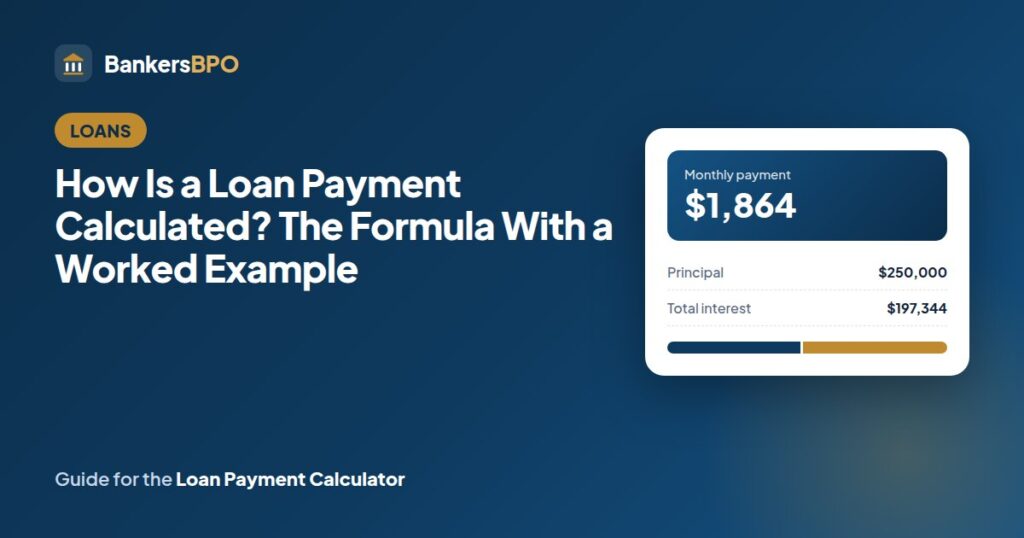
- Payment = 4,943.4 ÷ 2.6504 = $1,864 a month.
Over 240 months you pay 1,864 × 240 = $447,344 in total. Subtract the $250,000 you borrowed and the interest comes to about $197,344. On a 30-year term at the same rate, interest would be $318,861, more than the loan itself. That surprises most first-time borrowers, and it is the single best argument for a shorter term or extra payments.
This is principal and interest only. A mortgage payment to your servicer also includes escrow for property tax and homeowners insurance, and PMI if your down payment was under 20%. Those can add several hundred dollars a month, so compare the calculator’s figure with the principal-and-interest line on your loan estimate, not the total.
Where the first payment goes
Month one: interest = 250,000 × 0.0054167 = $1,354. The payment is $1,864, so only $510 reduces the loan. Your balance after the first payment is $249,490.
Month two: interest = 249,490 × 0.0054167 = $1,351. Principal paid = $513. The interest fell by $3 and the principal rose by $3. That shift continues every month, which is why the amortization schedule looks lopsided: 72% of the first year’s payments is interest, and the loan is still 86% unpaid after five years.
What changes the payment
Three inputs drive the result, and they do not pull equally.
The loan amount scales the payment in proportion. Borrow 10% more and the payment is 10% higher. Nothing clever there.
The rate matters more than it looks. On the $250,000, 20-year loan, each quarter-point costs about $37 a month and roughly $9,000 over the term. A rate of 7.5% instead of 6.5% pushes the payment to $2,014 and total interest to $233,000. This is why rate shopping and refinancing are worth the paperwork.
Term has the strangest effect. Stretching from 20 to 30 years drops the payment only from $1,864 to $1,580, a saving of $284 a month, but adds $121,500 of interest. Cutting from 20 to 15 years raises the payment to $2,178, $314 more a month, and saves $55,000. Longer terms buy affordability at a steep price; shorter ones are the cheapest loan you can get if the payment fits.
| Term | Payment | Total interest |
|---|---|---|
| 10 years | $2,839 | $90,644 |
| 15 years | $2,178 | $141,998 |
| 20 years | $1,864 | $197,344 |
| 25 years | $1,688 | $256,405 |
| 30 years | $1,580 | $318,861 |
Add-on rate quotes are a different animal
Some dealer financing, furniture and appliance plans and small-business loans are quoted at an add-on rate, where interest is charged on the full original amount for the whole term. An 8% add-on rate on a 3-year loan costs about the same as 14.5% APR. Federal law requires the APR to be disclosed before you sign, so if a quote seems cheap, find the APR line or run it through the add-on rate to APR converter. The formula above applies to amortizing loans, which is what every mortgage and nearly every bank auto and personal loan is.
The same formula, read backwards
Once you know the formula you can run it the other way. If a lender tells you the maximum payment it will allow, the loan it supports is M × ((1 + r)^n − 1) ÷ (r × (1 + r)^n). At 6.5% over 30 years every $1,000 of monthly payment supports about $158,211 of loan, so a $2,500 payment supports roughly $395,500. Lenders use exactly this to turn your income into a maximum loan, which is what the how much can I borrow calculator does with a debt-to-income limit.
You can also find the rate hidden in a quote. If a dealer says “$10,000, pay $340 a month for 36 months”, the total is $12,240, interest is $2,240, and solving the formula for r gives about 13.6% APR, whatever the brochure says.
Why the lender’s payment may differ by a few dollars
Your loan estimate may show a payment a few dollars away from the calculator. The usual reasons:
- Rounding. Some lenders round the payment up to the next dollar.
- Daily versus monthly interest. A few lenders, mostly on auto and personal loans, compute interest daily, which changes the split slightly and makes paying early matter more.
- Odd days interest. If the loan funds mid-month, the first charge covers the days to the first full payment date and is collected at closing.
- Financed fees. An origination fee rolled into the loan raises the principal, so the payment is on more than the amount you receive.
Differences bigger than a few dollars usually mean a different rate or term than you think you agreed to, so read the estimate again.
Checking a quote in two minutes
Open the loan payment calculator, enter the amount, rate and term from the offer, and compare the payment with the lender’s principal-and-interest figure. Then look at the split bar: if interest is close to or more than principal over the life of the loan, as it is for most 30-year mortgages, consider whether a shorter term fits your income. For more tools, start at the homepage.
FAQs
Does the payment change if the interest rate changes?
On a fixed-rate loan, no. On an adjustable-rate mortgage the rate resets on a schedule, usually yearly after an initial fixed period, and the payment is recalculated on the remaining balance and term at the new rate. Caps on each adjustment and over the life of the loan limit how far it can move.
Is the payment calculated on the full loan amount or the amount I receive?
On the full principal, which includes any fees you finance. If a $250,000 loan has $3,000 of closing costs rolled in, the payment is on $253,000. The loan estimate shows both figures; the calculator wants the one the lender calls “loan amount”.
Why is the interest more than the loan itself on a 30-year mortgage?
Because the balance stays large for many years. At 6.5%, a $250,000 loan accrues about $16,000 of interest in the first year alone, and the balance falls slowly, so the interest keeps coming. Total interest exceeds principal on most 30-year loans at rates above about 6%.
Can I calculate the payment in Excel?
Yes. The PMT function does it: =PMT(6.5%/12, 240, -250000) returns 1,864. Enter the principal as a negative number so the result comes out positive. The calculator on this site uses the same formula and shows the schedule too.
Does an origination fee change the payment?
Only if it is financed. A fee paid at closing does not touch the payment but raises the true cost of the loan, which is why the APR on your disclosure is higher than the note rate. The refinance calculator asks for closing costs before telling you whether a switch saves money.
What is a good payment as a share of income?
Mortgage lenders generally cap your housing payment at 28% of gross income and all debt payments together at 36%, with exceptions up to 43 to 50% for strong files. Many advisers suggest staying under 28% so that a tax increase or a job gap does not become a crisis. The how much can I borrow calculator lets you set the share and see the loan it supports.