English (India)
 Español
 Português
 Français
 Deutsch
 Italiano
 العربية
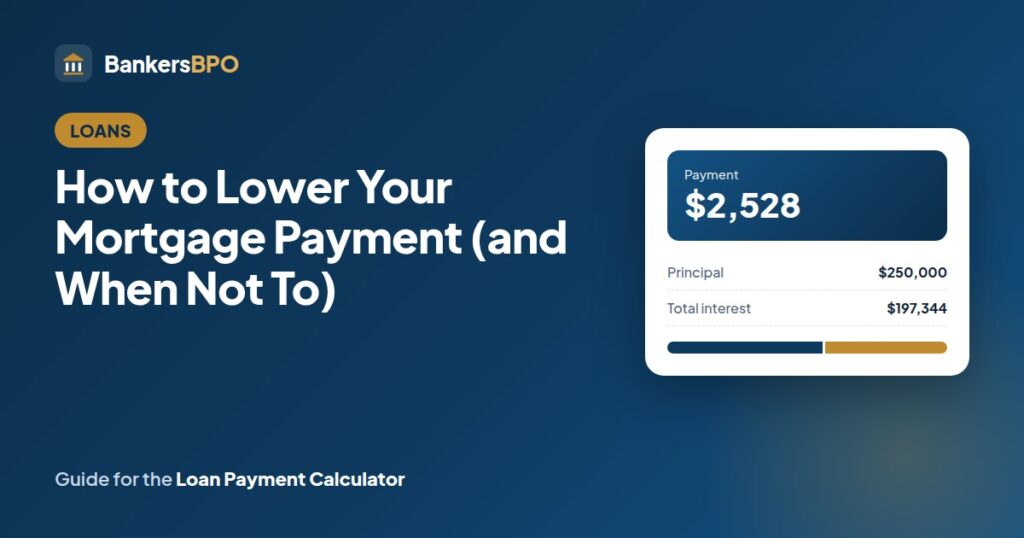
If you are searching for how to lower your mortgage payment, there are five honest ways, and one of them is a trap. This guide prices each option on the same $400,000 loan, so you can see the monthly relief and what it costs over the life of the loan. Run your own numbers in the loan payment calculator as you go; the figures below use 6.5% and a 30-year term, which gives a principal-and-interest payment of $2,528, and they assume you are three years in with a balance of $385,669.
Option 1: recast after a lump sum
A recast is the cheapest trick in mortgage lending and the least known. You pay a lump sum toward principal, usually $5,000 or more, and the servicer re-amortizes the remaining balance over the remaining term. The rate and the end date stay the same; the payment falls. Most servicers charge $150 to $500 and do not require a credit check or appraisal. Loans backed by Fannie Mae and Freddie Mac allow it; FHA and VA loans generally do not.
A $20,000 lump sum three years in takes the balance to $365,669 and the payment from $2,528 to $2,397, a saving of $131 a month and $22,480 of interest over the remaining 27 years. Compare that with putting the same $20,000 in and leaving the payment alone: the loan ends 40 months early and saves $81,131 of interest, but the payment does not move. The extra payment calculator shows both choices side by side. Pick the recast when cash flow is the problem; pick the shorter term when total cost is.
Option 2: refinance to a lower rate, same remaining term
If rates have fallen since you closed, a rate-and-term refinance replaces the loan with a cheaper one. Keeping the remaining 27 years, a refinance from 6.5% to 6.0% lowers the payment to $2,407, a saving of $122 a month and $39,448 of interest. At 5.5% the payment is $2,288 and the saving $241 a month.
Closing costs are the catch: typically 2 to 5% of the loan, so $8,000 to $19,000 here. The refinance calculator takes the balance, both rates, the remaining term and the costs, and tells you the net saving and the break-even month. As a rough rule, a refinance is worth it when the rate drops at least half a point, you will keep the home past the break-even, and you do not reset the term.
Option 3: the term reset, which is the trap
Most refinances are written as new 30-year loans. On the same balance at 6.0%, a fresh 30-year term drops the payment to $2,312, a saving of $216 a month, more than option 2. It also adds three years to the loan and, after closing costs, about $13,000 more interest than keeping the 27-year term, even at the lower rate.
The relief is real, but you pay for it several times over. A term reset makes sense in two cases: a genuine cash squeeze where the alternative is a missed payment, or a plan to pay extra later once income recovers. If you take the new 30-year loan, ask the lender to price a 25- or 20-year term as well; the payment difference is often smaller than you expect.
Option 4: remove PMI
If your down payment was under 20%, you are paying private mortgage insurance, usually 0.5 to 1.5% of the loan a year, or $170 to $500 a month on this loan. Federal law requires the servicer to cancel it automatically when the balance reaches 78% of the original value, and you can request cancellation at 80%. If home prices have risen, you can also ask for a new appraisal to show you have reached 20% equity sooner. This is the only option on the list that lowers the payment with no change to the loan and no cost beyond an appraisal. Servicers do not always volunteer it, so put the request in writing and keep a copy of the payment history showing you are current, which is a condition of cancellation.
Option 5: check the escrow
Your total payment includes escrow for property tax and homeowners insurance, and that part changes every year. A reassessment, a premium increase or an escrow shortage from last year can add $100 or more a month. Read the annual escrow analysis your servicer sends. Appeal the property assessment if comparable homes are valued lower, shop the insurance policy, and if the shortage is being collected over 12 months, ask to pay it as a lump sum instead. None of this touches principal and interest, but it can be the quickest win.
What each option costs per dollar of relief
| Option | Monthly relief | Change in total interest | Cash or fees needed now |
|---|---|---|---|
| Recast with $20,000 | $131 | −$22,480 | $20,000 plus a $150 to $500 fee |
| Refinance to 6.0%, keep 27 years | $122 | −$39,448 | $8,000 to $19,000 |
| Refinance to 6.0%, new 30 years | $216 | +$13,261 | $8,000 to $19,000 |
| Remove PMI | $170 to $500 | nil | appraisal, if needed |
| Escrow review | varies | nil | nil |
Only the term reset raises the cost of the loan; the others lower it or leave it alone. PMI removal and the escrow review come first because they cost almost nothing. The recast gives steady relief for the price of the lump sum. The refinance makes sense when the rate gap covers the closing costs.
What not to do
Do not stop paying and hope to negotiate. A missed payment is reported to the credit bureaus after 30 days and stays on your report for seven years. If you are about to miss one, call the servicer before the due date and ask about forbearance or a loan modification; both are hardship tools that do not count as default if agreed in advance.
Do not take a personal loan or a cash advance to make mortgage payments. Those rates are two to four times a mortgage rate, so you are replacing cheap debt with expensive debt.
Do not confuse a lower payment with a cheaper loan. Every option that lowers the payment without reducing the balance or the rate costs more in total. Decide whether you want monthly relief or lower total cost, because except for a recast and a rate cut, you cannot have both.
Putting the options together
A sequence that works: check PMI and escrow first, because they are free. Then get a refinance quote and run it through the calculator with the remaining term, not a new 30-year one. Use a recast whenever a bonus or inheritance arrives and cash flow is tight; otherwise make the extra payment and keep the payment unchanged. Leave the term reset as the last resort.
Before any of these, check what your income can carry with the how much can I borrow calculator, which applies the same debt-to-income limit lenders use. Then go back to the loan payment calculator with the new rate or balance and confirm the new payment matches what the lender quotes. All the tools are listed on the homepage.
FAQs
Will my payment go down if the Fed cuts rates?
Not on a fixed-rate mortgage; the rate is locked for the life of the loan. Fed cuts tend to lower the rates offered on new loans, which makes a refinance cheaper. On an adjustable-rate mortgage the payment resets on its schedule at the new index rate, so a cut flows through at the next adjustment.
Does a recast affect my credit score?
No. A recast is an administrative change to an existing loan, with no credit pull and no new account. A refinance creates a new loan and a hard inquiry, which can dip the score by a few points for a few months.
Is it better to recast or to make the extra payment and keep the term?
Keeping the payment saves far more interest, because the full payment keeps attacking the principal. The recast saves less but frees cash every month. If the payment is comfortable, keep it; if it is a strain, recast. The extra payment calculator shows the interest saved under both.
How much does a refinance cost?
Expect an origination fee of 0.5 to 1% of the loan, an appraisal of $400 to $700, title and settlement fees of $1,000 to $3,000, and recording and transfer taxes that vary by state. “No closing cost” refinances fold the fees into a higher rate. Add them all up before comparing, because they are what the saving has to recover.
Can a bigger down payment lower the payment on a loan I already have?
No. A larger down payment only applies before closing: putting down $100,000 instead of $80,000 on a $480,000 home at 6.5% over 30 years cuts the payment from $2,528 to $2,402. Once the loan is running, the same effect comes from a lump-sum payment followed by a recast.
Does adding a co-borrower lower the payment?
No. A co-borrower raises the income the lender counts, which raises how much you can borrow and can help you qualify for a lower rate. The payment on a given loan amount, rate and term is the same regardless of how many people sign.