English (India)
 Español
 Português
 Français
 Deutsch
 Italiano
 العربية
Two loans, both “8%”. One costs $1,281 in interest, the other $2,400. The difference is add-on interest vs APR, and it is the oldest trick in consumer lending. This guide shows both methods on the same $10,000, three-year loan, explains why federal law requires the APR to be disclosed, and tells you where add-on quotes still turn up. Convert any quote you are given in the add-on rate to APR converter before you sign.
What an add-on rate is
An add-on rate (also called a flat rate, or precomputed interest in older contracts) charges interest on the original loan amount for the whole term. The lender multiplies the amount by the rate and the number of years, adds that interest to the principal, and divides by the number of months to get the payment.
$10,000 at 8% add-on for 3 years: interest = 10,000 × 0.08 × 3 = $2,400. Total to repay = $12,400. Payment = 12,400 ÷ 36 = $344 a month.
The flaw is in the first line. You do not owe $10,000 for three years. After the first payment you owe less, and after 18 payments you owe about half. An add-on rate ignores this and charges you as if the whole amount were outstanding until the last day.
What APR is
APR, the annual percentage rate, is the rate on what you actually owe each month, which is how amortizing loans work. It is the figure the Truth in Lending Act requires every consumer lender to disclose, in the same box on every contract, so that two loans can be compared.
$10,000 at 8% APR for 3 years: the monthly rate is 0.667%, the payment from the amortizing formula is $313, and total interest is $1,281. The loan payment calculator gives the same figures, and the amortization schedule shows the interest falling every month as the balance drops.
The same loan both ways
| 8% add-on | 8% APR | |
|---|---|---|
| Monthly payment | $344 | $313 |
| Total interest | $2,400 | $1,281 |
| True APR | 14.55% | 8.00% |
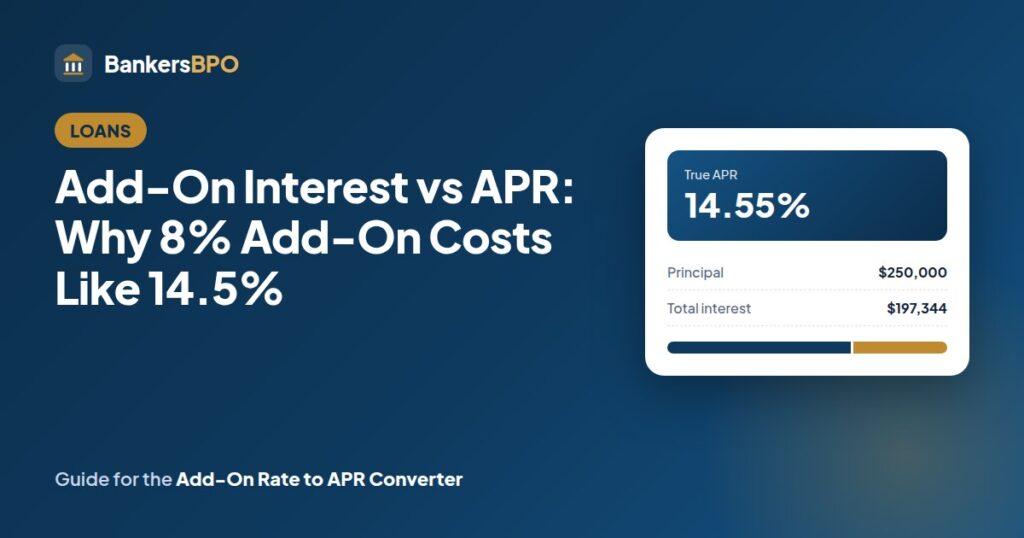
The add-on loan costs 87% more interest for the same headline rate. Its true APR, the rate that produces a $344 payment on an amortizing $10,000 loan, is 14.55%. That number, not 8%, is what the lender must print in the disclosure box.
Why the gap is roughly double
The average balance on an amortizing loan over its term is a little more than half the original amount. Charging the full rate on the full amount is therefore close to charging twice the rate on the average balance. The exact ratio depends on the term: short loans convert at a bit under double, long loans at a bit over.
| Add-on rate | 1 year | 3 years | 5 years |
|---|---|---|---|
| 4% | 7.3% APR | 7.5% APR | 7.4% APR |
| 8% | 14.5% APR | 14.5% APR | 14.1% APR |
| 12% | 21.5% APR | 21.2% APR | 20.3% APR |
A quick mental check: double the add-on rate and subtract a little. The converter does it exactly.
Where add-on quotes still appear
Dealer financing at buy-here-pay-here car lots, where the contract may be written as precomputed interest with the full finance charge fixed at signing. Rent-to-own and some furniture and appliance plans. Older installment contracts in some states. Small-business and merchant cash advance offers, which often quote a “factor rate” such as 1.2, meaning you repay $12,000 on $10,000, with no term stated at all; on a six-month repayment that is an APR well above 60%. Some payday and title lenders, though their disclosures are a separate subject.
Bank, credit union and online personal loans, auto loans from mainstream lenders, mortgages and credit cards are all APR-based and amortize normally.
Reading the Truth in Lending box
The federal disclosure is a four-cell box near the top of the contract, and it is the same on a car loan, a furniture plan and a personal loan. The cells are the annual percentage rate, the finance charge in dollars, the amount financed, and the total of payments. Below it, a payment schedule lists the number, amount and timing of payments.
On the example add-on loan the box would read: APR 14.55%, finance charge $2,400, amount financed $10,000, total of payments $12,400. The salesperson’s “8%” appears nowhere in it. If the box is missing, unsigned or filled in after you sign, the contract has a legal problem and you should walk away.
Two checks take thirty seconds. First, the finance charge divided by the amount financed, divided by the term in years, is the add-on rate; if it matches the rate you were quoted, the quote was add-on. Second, the APR cell should be close to double that figure. If it is not, there are fees in the finance charge beyond the interest.
Two other disguises
“Zero percent financing” with a documentation or acquisition fee. A $500 fee on a $10,000, 12-month loan is a 5% finance charge collected up front, which the disclosure box must show as an APR of about 9.5%. The rate is real; the fee is the interest.
“Interest-free if paid in full within 12 months”. Deferred-interest plans on store cards charge no interest if the balance is cleared by the deadline and the full accrued interest from day one, often at 25 to 30%, if even a dollar remains. That is not add-on interest, but it is the same instinct: a headline number that is not the cost. Set a calendar reminder two months before the deadline, and pay the balance in full rather than in instalments that leave a remainder.
What precomputed interest does to prepayment
On an amortizing loan, paying off early saves all the interest that had not yet accrued. On a precomputed loan the full finance charge was added at signing, so paying early requires a rebate of the unearned interest, and many contracts calculate it by the Rule of 78s, which front-loads the interest and returns less than a straight proportion. Federal law bans the Rule of 78s on consumer loans longer than 61 months and several states ban it entirely, but it survives in short contracts. If a contract says “precomputed” or “Rule of 78”, assume early payoff saves less than you expect, and ask for the rebate method in writing.
What to do with an add-on quote
Find the APR box. The Truth in Lending disclosure must show the APR, the finance charge, the amount financed and the total of payments. If the APR box shows 14.5% and the salesperson said 8%, the 14.5% is the real rate.
If there is no disclosure yet, convert the quote yourself. Enter the amount, the add-on rate and the term in the add-on rate to APR converter and compare the APR with what a bank or credit union would charge. For a borrower with fair credit, a credit union personal loan at 12% APR beats an 8% add-on loan at 14.5% APR, and the salesperson will not point that out.
Then check that the payment fits. The how much can I borrow calculator applies the debt-to-income test a mainstream lender would run. All the tools are on the homepage.
FAQs
Is an add-on rate illegal?
No. It is a legal way to compute a finance charge, as long as the resulting APR is disclosed under the Truth in Lending Act and does not exceed the state’s usury limit. What is illegal is advertising the add-on rate as if it were the APR, which happens anyway and is why the disclosure box matters.
How do I know if my loan is add-on or APR-based?
Look for the words “precomputed”, “add-on” or “Rule of 78s” in the contract, or compare the finance charge with the amount financed and the term: if the finance charge equals amount × rate × years exactly, it is add-on. An APR-based loan’s interest is lower than that product. A payoff quote that does not fall over time is another sign.
Is a factor rate the same as an add-on rate?
Close. A factor rate of 1.2 on $10,000 means a $2,000 fixed charge, like a 20% add-on rate over the repayment period, except the period is often a few months, which makes the APR far higher. Divide the charge by the amount, then annualize it for the actual repayment period to see what you are paying.
Does the APR include fees?
Yes. The APR folds origination fees and most other lender charges into the rate, which is why it is usually a little higher than the note rate on a mortgage. Comparing APRs is the fairest way to compare loans with different fee structures, as long as the terms are the same.
Why does the converter give a slightly different APR than my contract?
The contract APR may include fees, which the converter does not, or the lender may use a daily or 360-day interest method. A difference of a few tenths of a point is normal. A difference of several points means the contract has charges beyond the add-on interest.
Can I refinance a precomputed loan into a normal one?
Yes, with a personal loan from a bank or credit union, as long as the payoff rebate on the old loan leaves enough saving to justify it. Get the payoff figure in writing first; on a Rule of 78s contract it will be higher than the amortized balance would be.