English (India)
 Español
 Português
 Français
 Deutsch
 Italiano
 العربية
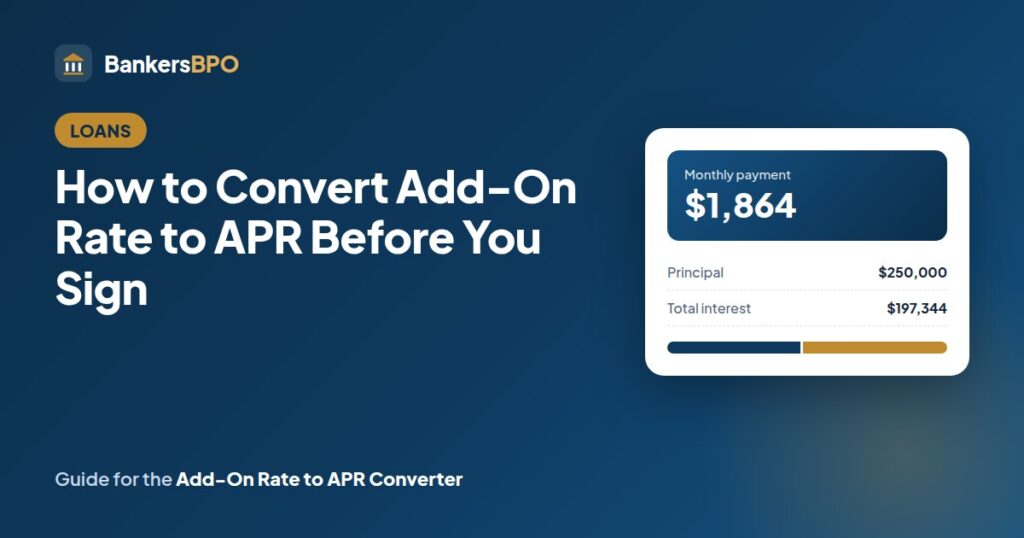
You are on a sales floor, the finance manager says “8% over three years”, and you need to know what that means before the paperwork arrives. Here is how to convert add-on rate to APR in your head in ten seconds, exactly in two minutes, and what to ask so the answer is in writing. The add-on rate to APR converter does the exact version; the methods below let you check it and understand why the number comes out as it does.
Why the conversion is needed
An add-on rate charges interest on the original amount for the whole term. APR charges it on the declining balance. Because the average balance on an amortizing loan is a little over half the original, an add-on rate of x costs about the same as an APR of nearly 2x. A quote of 8% add-on is a loan at roughly 14.5% APR, and federal law requires that 14.5% to appear in the Truth in Lending box on the contract. The conversion tells you what to expect in that box before you see it.
Method 1: the rule of thumb
Double the add-on rate and knock off a little. The “little” is about half a point on a one-year loan and a point or more on a five-year loan, because the longer the term, the more time the balance spends below its average.
| Add-on rate | Rule of thumb | Exact APR, 3 years |
|---|---|---|
| 4% | about 7.5% | 7.5% |
| 6% | about 11% | 11.1% |
| 8% | about 15% | 14.5% |
| 10% | about 19% | 17.9% |
| 12% | about 22% | 21.2% |
Good enough to decide whether to keep talking. A 6% add-on quote on a car loan when your credit union offers 7.5% APR is not a close call; it is nearly four points worse.
Method 2: the exact conversion
The exact APR is the rate at which an amortizing loan of the same amount and term has the same monthly payment as the add-on loan. Three steps.
- Work out the add-on payment. Interest = amount × rate × years. Payment = (amount + interest) ÷ months. For $10,000 at 8% over 3 years: interest $2,400, payment $344.44.
- Find the APR that gives that payment on an amortizing loan. There is no closed formula; it is solved by trial. The converter does this by bisection, trying rates until the amortizing payment matches to the cent.
- Read off the result: 14.55%.
In Excel or Google Sheets, step 2 is one function: =RATE(36, -344.44, 10000) × 12 returns 14.55%. Enter the payment as a negative number. The loan payment calculator does the reverse check: enter $10,000 at 14.55% for 36 months and the payment comes out at $344.
Method 3: the constant-ratio formula
Before calculators, lenders used an approximation called the constant-ratio method: APR ≈ 2 × m × I ÷ (P × (n + 1)), where m is the number of payments a year, I the total interest, P the principal and n the total number of payments. For the example: 2 × 12 × 2,400 ÷ (10,000 × 37) = 15.6%. It overstates the APR by about a point on a three-year loan, which is why it was a rule of thumb for regulators rather than a disclosure method. It is still a useful sanity check when you have the finance charge and the term and no calculator.
A worked dealer example
A used car is $18,000. You put $3,000 down and the dealer offers “7% for 48 months”. Amount financed $15,000. If that 7% is add-on: interest = 15,000 × 0.07 × 4 = $4,200, total $19,200, payment $400. The rule of thumb says about 13%; the exact conversion gives 12.7% APR. A credit union pre-approval at 8.5% APR on the same $15,000 over 48 months has a payment of $370 and total interest of $2,747. The dealer’s “7%” costs $1,453 more than the credit union’s “8.5%”.
Now suppose the contract arrives with an APR of 14.7%. The extra two points are fees. Ask what was added to the amount financed; a $600 documentation fee and a $900 service contract would account for it, and both can be declined or negotiated before you sign.
Converting a factor rate
Small-business offers often skip rates altogether and quote a factor: “1.25 on $20,000, repaid daily over 8 months”. The charge is $5,000 on $20,000, 25% of the amount, over two-thirds of a year. As a simple rate that is 37.5% a year; as an APR on a loan repaid in daily instalments, where the average balance is about half, it is in the 60 to 70% range. The converter handles this if you enter the charge as the add-on interest over the term, but the honest comparison is with a bank line of credit at a fraction of that cost.
Reading the contract once it arrives
The disclosure box shows the APR, the finance charge, the amount financed and the total of payments. Check three things.
The APR should be close to your conversion. If you converted 8% add-on to 14.5% and the box says 17%, there are fees inside the finance charge: a documentation fee, an extended warranty, credit insurance or GAP coverage added to the loan. Each one is optional unless the contract says otherwise, and each one can be removed before you sign.
The amount financed should be the price minus your down payment and trade-in, plus any add-ons you agreed to. If it is higher, something was added.
The total of payments divided by the number of payments should equal the monthly payment you were told. Dealers sometimes quote a payment on a longer term than the one in the contract.
Questions to ask before the paperwork
“Is that rate the APR?” The honest answer to an add-on quote is no, and a finance manager who says yes to this question about an add-on rate is misrepresenting the loan.
“What is the finance charge in dollars?” This number cannot be dressed up. Divide it by the amount and the years to get the add-on rate, and compare with the quote.
“Is the interest precomputed, and how is the rebate calculated if I pay early?” Precomputed contracts with a Rule of 78s rebate return less than a proportional share of the interest on early payoff. Ask for the actuarial method, or avoid the loan.
“Can I see the loan at 48 months and at 36?” Longer terms lower the payment and raise the total interest, and the add-on method makes the longer term look better than it is.
Walking in with your own financing
The simplest defence is a pre-approval from a bank or credit union before you shop. Then the dealer’s rate has a number to beat, and the conversation moves from monthly payment to APR, where add-on arithmetic cannot hide. The how much can I borrow calculator will tell you what payment a lender is likely to allow against your income. Take the pre-approval letter with you, and if the dealer’s APR is lower, let them have the loan; if it is higher, use your own.
When the numbers are in front of you, run them through the add-on rate to APR converter once more with the exact amount, rate and term from the contract. The APR it returns should match the box. All the tools are on the homepage.
FAQs
Can I convert APR back to an add-on rate?
Yes: work out the amortizing payment at the APR, multiply by the number of months, subtract the principal to get total interest, and divide by principal and years. A 14.5% APR three-year loan on $10,000 has $2,392 of interest, which is 7.97% add-on. It is useful when a dealer quotes add-on and a bank quotes APR and you want both in the same units.
Is the converter’s APR the same as the contract’s APR?
If the finance charge is interest only, yes, to within rounding. If the contract adds fees to the finance charge, the contract APR is higher. If the lender uses a 360-day year or daily accrual, the figures differ by a few hundredths. A gap of more than half a point means fees.
Why does a longer term give a slightly lower APR for the same add-on rate?
Because the balance spends more of a long term well below the original amount, so charging the full rate on the full amount overstates the true rate by a little less in relative terms. The effect is small: 8% add-on is 14.5% APR at three years and 14.1% at five. The total interest is still far higher on the longer loan.
Does the Truth in Lending Act apply to business loans?
No. It covers consumer credit for personal, family or household purposes. Business loans, merchant cash advances and equipment financing have no federal APR disclosure requirement, which is why factor rates and add-on quotes are common there. A few states now require APR-style disclosures on small-business financing.
What is a reasonable APR on a used car loan?
It depends on credit score and the age of the car. Credit union rates for good credit have been in the 6 to 9% range in recent years, bank rates a little higher, and subprime dealer financing well above 15%. If your converted add-on quote is above 15%, a credit union is almost certainly cheaper.
Can I negotiate the add-on rate?
Yes, but negotiate the APR instead, or the finance charge in dollars, so the comparison is honest. Dealers have discretion on the rate they mark up above the lender’s buy rate, and asking for the buy rate, or walking in with a pre-approval, usually removes most of the markup.