English (India)
 Español
 Português
 Français
 Deutsch
 Italiano
 العربية
A bonus, an inheritance or a tax refund lands, and you decide to put $20,000 into the mortgage. The servicer will do one of two things with it, and the choice is worth about $47,000. This guide works through the choice, shorten term or lower payment, on the same $300,000 loan so you can see what each option does to the interest, the end date and the monthly bill. Run your own numbers in the extra payment calculator as you go; the figures below use 6.5% over 30 years, a payment of $1,896, and assume you are five years in with a balance of $280,833 and 25 years left.
What happens when you pay extra
On an amortizing loan, any money beyond the scheduled payment that is marked for principal reduces the balance the day it is applied. From that day on, every month’s interest is calculated on the smaller balance. Nothing else changes by itself: the rate is the same, the scheduled payment is the same, and the loan simply reaches zero sooner than the original schedule said. That is option one, shortening the term, and it is what happens by default.
Option two needs a request. A recast, also called re-amortization, asks the servicer to spread the new, smaller balance over the original remaining term. The end date stays put and the payment falls. Most servicers charge $150 to $500 and require a minimum lump sum, often $5,000 or $10,000. Conventional loans allow it; FHA, VA and USDA loans generally do not, and jumbo loans depend on the investor.
The same ,000, two ways
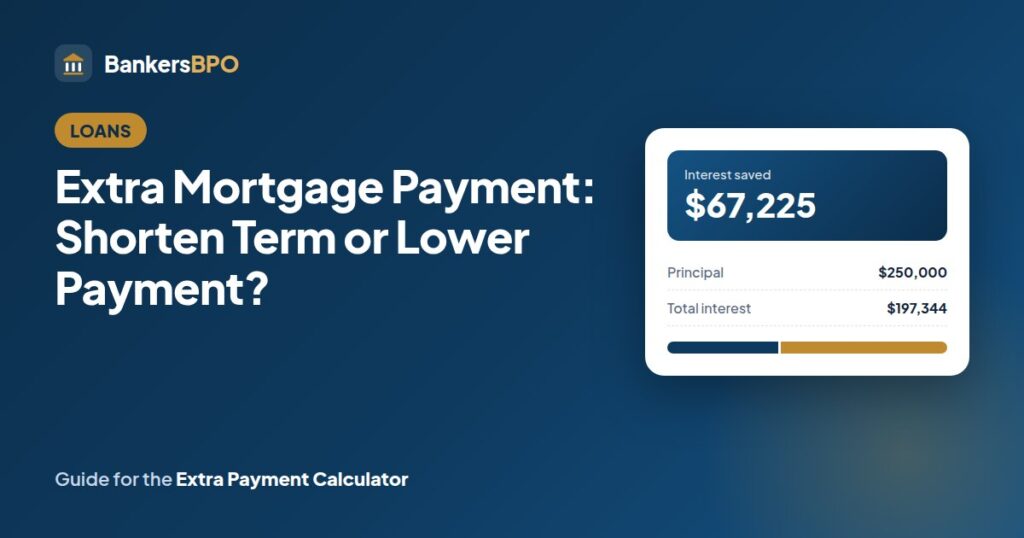
Paying the $20,000 and leaving the payment alone takes the balance to $260,833. The $1,896 payment now clears it in 254 months instead of 300, so the loan ends 46 months, almost four years, early. Interest over the rest of the loan falls by $67,225.
Paying the same $20,000 and recasting keeps the 300-month term. The payment drops from $1,896 to $1,761, a saving of $135 a month. Interest over the rest of the loan falls by $20,512.
| No extra payment | Shorten the term | Recast (lower the payment) | |
|---|---|---|---|
| Monthly payment | $1,896 | $1,896 | $1,761 |
| Months left | 300 | 254 | 300 |
| Interest still to pay | $288,000 | $220,800 | $267,500 |
| Interest saved | $67,225 | $20,512 |
Shortening the term saves more than three times as much, because the full payment keeps attacking a shrinking balance for 254 months. The recast gives back $135 a month and keeps $46,700 of interest on the table.
Why timing matters more than the choice
The same $20,000 paid at year fifteen instead of year five, with a balance of $217,677 and 180 months left, saves $29,301 by shortening the term and $11,360 by recasting. The lump sum is identical; the saving is less than half. Early in a loan the balance is large and the interest ahead of you is large, so removing principal removes a lot of future interest. Late in the loan most of the interest has already been paid, and there is little left to save. The amortization schedule shows this directly: look at the interest column for the years that remain.
A monthly extra instead of a lump sum
You do not need a windfall. Adding $200 a month from year five, with no recast, clears the loan in 240 months instead of 300, cutting five years, and saves $66,944, almost exactly what the $20,000 lump sum saved. Over those 240 months you pay in $48,000 extra, so the lump sum is the better deal per dollar, but the monthly route is the one most people can actually do. Set it up as an automatic transfer marked for principal, and check the next statement to confirm it was applied that way and not held as a prepayment of next month’s bill.
When each option fits
Shorten the term when the payment is comfortable and the goal is total cost or a debt-free date: retirement in fifteen years, say, with the house paid off. It is also the right default when you are not sure, because you can always recast later and you cannot undo a recast.
Recast when cash flow is the problem: a drop in income, a new child, a second mortgage on a rental, or simply a payment that was always a stretch. The $135 a month is real relief, and it costs far less than a refinance. Recasting also suits borrowers who sold a previous home after buying the new one and want the sale proceeds to lower the payment they had to qualify for without them.
A hybrid works too: recast now for relief, and once income recovers, resume extra payments that shorten the term. The servicer will apply them to principal just as before.
How the servicer handles the request
For the shorten-the-term route, nothing needs to be requested; send the money marked for principal and the balance drops. Online payment portals usually have an “additional principal” box; by mail, write it on the check and on the coupon. If the servicer applies it as an advance on next month’s payment instead, call and have it reversed; they can do this within the same billing cycle without trouble.
For a recast, call the servicer or use the online request form, pay the fee, and send the lump sum. The servicer confirms the new payment in writing, usually within 30 to 45 days, and the new amount starts with the next full billing cycle. Keep paying the old amount until the confirmation arrives. The loan documents do not change, the rate does not change, and nothing is reported to the credit bureaus; it is an accounting change inside an existing loan.
Three things to check first
Prepayment penalties. Rare on mortgages written since 2014, but check the closing disclosure; the box is on page 1.
Your emergency fund. A lump sum into the mortgage is gone; you cannot take it back without a cash-out refinance or a home equity line. Keep three to six months of expenses in cash before you pay extra, and more if your income is variable or your industry is cyclical. The mortgage will still be there next year; a cash gap will not wait.
Higher-rate debt. A $20,000 card balance at 24% costs $4,800 a year; the same $20,000 in a 6.5% mortgage saves $1,300 in the first year. Pay the card first. The same logic applies, less sharply, to auto and personal loans above the mortgage rate.
Running your own numbers
Open the extra payment calculator and enter your current balance from the latest statement, the rate, the months left and the lump sum. The table shows both options side by side with the months cut and the new payment. If you are deciding between paying extra and refinancing to a lower rate, the refinance calculator compares the saving after closing costs. The loan payment calculator will show what the recast payment would be for any balance. Every tool is listed on the homepage.
FAQs
Do I have to tell the servicer the extra payment is for principal?
Yes. Write “apply to principal” on the memo line or choose that option online. Without it, many servicers treat the extra amount as an early payment of next month’s bill, which saves no interest. Check the next statement: the extra should appear in the principal column of the transaction activity.
Can I recast more than once?
Usually, yes, with the fee each time and the minimum lump sum met. Some servicers limit it to once a year. Each recast re-amortizes the current balance over the remaining term, so a second one lowers the payment again, and the fee is usually the same each time.
Is biweekly payment the same as paying extra?
Paying half the monthly amount every two weeks makes 26 half-payments a year, which is 13 monthly payments instead of 12. The extra payment goes to principal and shortens the term, so yes, it is a monthly-extra plan in disguise. Avoid third-party biweekly services that charge a fee; most servicers let you do it free, or you can just add a twelfth of the payment each month.
Does an extra payment lower my escrow?
No. Escrow collects property tax and insurance, which do not depend on the loan balance. An extra payment only affects principal and interest. PMI is the exception: reaching 20% equity faster lets you request its cancellation, which does lower the total payment.
Is it better to pay extra or invest the money?
If the expected after-tax return on the investment is higher than the mortgage rate, investing wins on paper; $20,000 at 7% for 25 years grows to $108,500 against $67,225 of interest saved. The saving on the mortgage is guaranteed and the investment is not, which is why many people split the money. The guide on when to pay off your mortgage early goes through the trade-off.
Will the servicer automatically shorten the term after a lump sum?
Yes. Without a recast request, the scheduled payment stays the same and the balance simply reaches zero earlier. The servicer’s online schedule may still show the original maturity date for a while; the payoff tracks the balance, not the date.