 English (India)
 Español
 Português
 Français
 Deutsch
 Italiano
 العربية
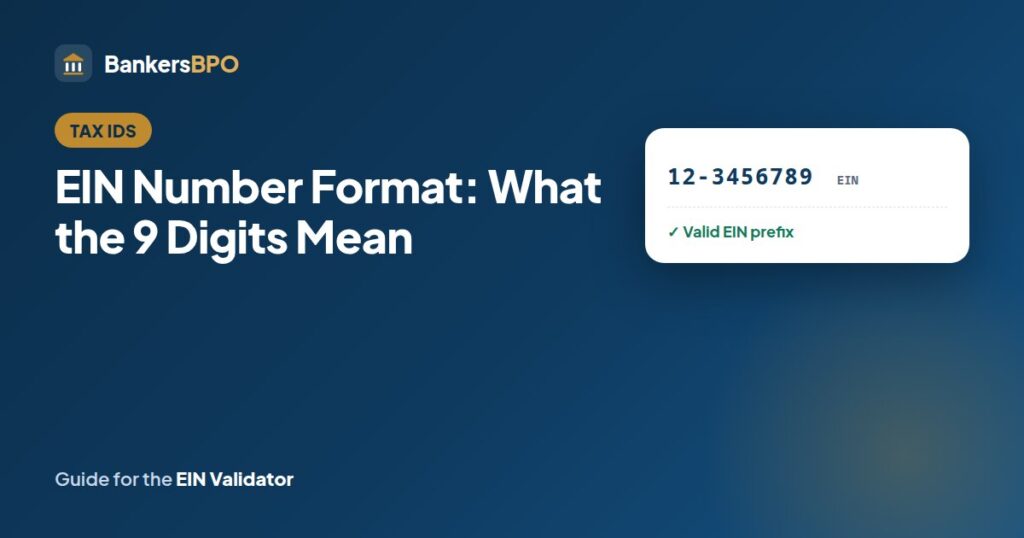
An Employer Identification Number looks like a Social Security number with the hyphen in the wrong place, and that is roughly what it is: a nine-digit federal tax ID, issued by the IRS to businesses, trusts, estates and nonprofits instead of to people. This guide covers the EIN number format, what the first two digits tell you, why the number has no check digit, how to tell an EIN from an SSN or ITIN at a glance, and where you will meet it. The EIN validator checks the format and the prefix of any number you enter.
The layout
An EIN is nine digits written as two, a hyphen, and seven: 12-3456789. The IRS calls it an Employer Identification Number whether or not the holder has employees; a sole proprietor with no staff, a trust, an estate and a church can all have one. It is also called a Federal Tax Identification Number, a federal tax ID or an FEIN on state forms. Once issued, an EIN is never reused or reissued, even if the business closes.
The hyphen is a formatting convention. Forms, databases and the validator accept the number with or without it, and the validator shows it in the hyphenated form so it can be compared with a W-9 or an IRS letter.
The prefix
The first two digits are the only part of an EIN with meaning. Before 2001 they identified the IRS service center that issued the number, so an EIN starting with 13 or 11 came from the Brooklyn center, 94 or 77 from Fresno, 04 or 01 from Andover. Since 2001 numbers have been assigned by the Cincinnati and Ogden campuses and, since the online application launched, by the internet system, which has its own prefixes (20, 26, 27, 45, 46, 47, 81, 82, 83, 84, 85, 86, 87, 88, 92, 93, 99 among them).
The practical use of the prefix is a sanity check. Only about 85 of the 100 possible two-digit prefixes have ever been issued; a number starting with 07, 08, 09, 17, 18, 19, 28, 29, 49, 69, 70, 78, 79, 89, 96 or 97 does not exist. The EIN validator carries the list of valid prefixes and flags a number whose prefix was never assigned, which catches a surprising share of typos and invented numbers.
The remaining seven digits are a sequence number with no structure, so nothing further can be read from them.
No check digit
Unlike a routing number, a credit card number or a European VAT number, an EIN has no checksum. A single mistyped digit produces another nine-digit number that may belong to a different business or to no one, and there is no arithmetic that will catch it. The validator can only confirm that the format is right and the prefix exists; whether the number is assigned, and to whom, requires a lookup, which the guide on how to verify an EIN covers.
This is why forms that collect EINs ask for the legal name alongside, and why the IRS runs name and TIN matching on information returns: the name is the check digit.
EIN, SSN and ITIN
Three federal tax IDs share the nine-digit length and are easy to confuse on a form.
| Number | Issued by | Issued to | Written as | First digits |
|---|---|---|---|---|
| EIN | IRS | Businesses, trusts, estates, nonprofits | 12-3456789 | Any valid prefix; never 9 as first digit in the ITIN pattern |
| SSN | Social Security Administration | Individuals | 123-45-6789 | Never 000, 666 or 900 to 999 in the first group |
| ITIN | IRS | Individuals not eligible for an SSN | 912-34-5678 | Always 9, with a fourth and fifth digit in the ranges the IRS assigns |
The hyphen position is the quickest tell: two digits then seven is an EIN; three, two, four is an SSN or ITIN. A sole proprietor may legitimately give either an SSN or an EIN on a W-9; a corporation or partnership must give an EIN. An ITIN starts with 9 and is never a business number, though the IRS has also issued EINs starting with 9 in the internet range, so the hyphen placement, not the first digit, settles it.
Where the EIN appears
On the IRS confirmation letter (CP 575) issued when the number is assigned, which is the document banks and payroll providers ask for. On Form W-9 when a business gives its tax ID to a customer or client. On Forms 1099 and W-2 as the payer’s or employer’s ID. On the business tax return, the Form 990 of a nonprofit (which is public), state registrations and sales tax permits, and on bank account and loan applications. Publicly traded companies print it on SEC filings. For nonprofits, the IRS Tax Exempt Organization Search shows it alongside the organization’s name.
An EIN is not confidential in the way an SSN is. It appears on public filings and is routinely shared with vendors and customers. Identity theft using an EIN exists, mostly to file fraudulent returns or open credit in the business’s name, so a business should still not post it where it does not need to be.
When a business needs an EIN
Any business with employees, any corporation or partnership, any business that files excise or employment tax returns, and most trusts and estates. A sole proprietor or single-member LLC with no employees can use the owner’s SSN but usually gets an EIN anyway, to avoid putting an SSN on every W-9. The IRS issues EINs free, online in minutes, by fax in a few days or by mail in a few weeks; paid “EIN filing services” are reselling the free form.
A new EIN is needed when the legal structure changes (a sole proprietor incorporates, a partnership becomes a corporation), and sometimes after a merger or bankruptcy; a change of name or address does not require one.
Reading an EIN off a document
On a W-9 the EIN sits in Part I, in boxes labelled Employer identification number, with the SSN boxes above it; a sole proprietor fills one or the other. On a 1099 the payer’s EIN is in the top left block under the payer’s name and address. On a CP 575 letter it appears in the header and again in the body, and the letter also names the entity exactly as the IRS holds it, which is the name to use on information returns. On a Form 990 it is on page one next to the organization’s name. In each case the number should read as two digits, a hyphen and seven digits; a nine-digit string with no hyphen is usually an EIN typed into a form that did not allow one, and a three-two-four pattern is an SSN that has been entered in the wrong box.
Checking a number
Enter the EIN with or without the hyphen in the EIN validator. A pass means nine digits with a prefix the IRS has used. It does not mean the number is active or belongs to the business in front of you; for that, match it to a W-9 or the IRS search, as the verification guide explains. When setting up the same vendor’s payment details, the routing number validator checks their bank number, and if sales tax is on their invoices, the sales tax calculator checks the arithmetic. All the tools are on the homepage.
FAQs
Can an EIN start with 0?
Yes. Prefixes 01 through 06 were issued by the Andover and Atlanta centers and are common on older businesses in the Northeast and Southeast. Enter the leading zero; spreadsheets that drop it turn a valid EIN into an eight-digit number that fails the format check.
Is the EIN the same as a state tax ID?
No. States issue their own numbers for sales tax, withholding and unemployment insurance, in their own formats. A state form asking for a “federal ID” wants the EIN; one asking for a “state ID” or “account number” wants the state’s number. Some states use the EIN as the base of their number.
Does an EIN expire?
No. Once issued, an EIN belongs to that entity permanently, even if it never files a return or the business closes. The IRS can deactivate it for its records on request but will not reassign it. A dormant EIN can be reactivated by filing a return.
Why does the validator accept an EIN that the IRS says does not exist?
Because the validator checks format and prefix only; it has no access to the IRS database, which is not public. Any nine-digit number with a valid prefix passes. The IRS lookup tools, a W-9 or the CP 575 letter establish whether the number is real and whose it is.
Can I look up a company’s EIN online?
For nonprofits, yes, through the IRS Tax Exempt Organization Search. For public companies, the EIN is on SEC filings in the EDGAR database. For private companies there is no public lookup; you ask the company for a W-9. Paid databases exist but are compiled from filings and are often out of date.
What is a “responsible party” on an EIN application?
The individual who controls the entity, named on Form SS-4 with their own SSN or ITIN. The IRS uses it to tie the EIN to a person for enforcement, and since 2019 the responsible party must be an individual, not another company. Changes must be reported on Form 8822-B within 60 days.