 English (India)
 Español
 Português
 Français
 Deutsch
 Italiano
 العربية
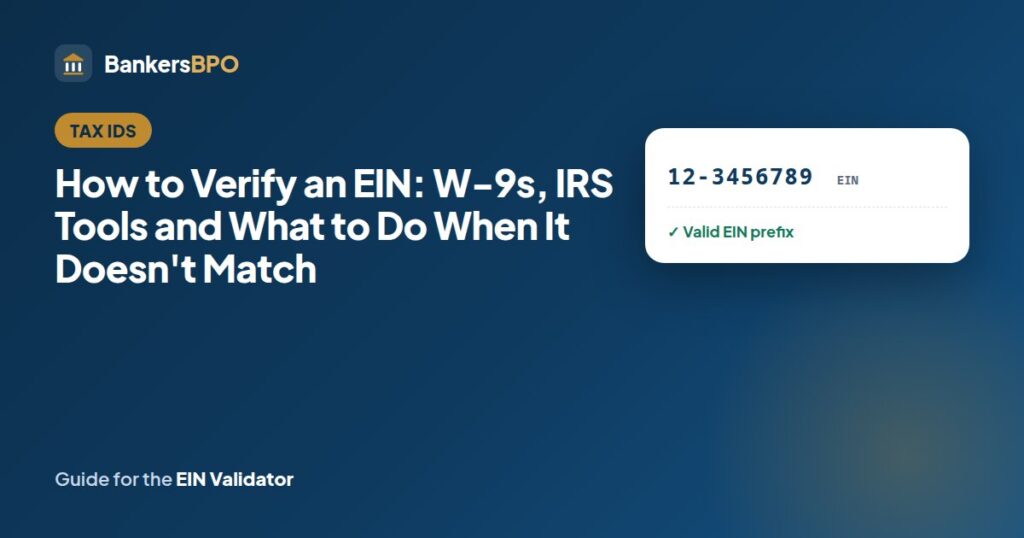
A new vendor sends an invoice and a W-9. Before you pay them, and certainly before you issue them a 1099 in January, you need to know that the EIN on the form is real and belongs to the name on it. This guide covers how to verify an EIN in four steps, from a thirty-second format check to the IRS’s own matching service, and what to do when the number and the name do not agree. Start with the EIN validator for the first step; the rest needs the IRS.
Step 1: check the format
Enter the number in the EIN validator. It confirms nine digits and a two-digit prefix the IRS has actually issued. About one in six possible prefixes has never been used, so a number starting with 07, 19, 49 or 89, for example, is not an EIN and the vendor has made a typo or invented it. The validator has no check digit to test, because EINs do not have one, so a pass means only that the number could exist.
This step catches transcription errors and the laziest fakes. It does not catch a real EIN that belongs to someone else, which is the case the remaining steps exist for.
Step 2: match it to the W-9
Form W-9, Request for Taxpayer Identification Number and Certification, is the document a US business gives its customers. It carries the legal name, any business or trade name, the tax classification, the address, the EIN or SSN, and a signature certifying under penalty of perjury that the number is correct. Ask every vendor for one before the first payment, and keep it for four years after the last.
Check three things against the W-9. The name on line 1 must be the legal name that goes with the EIN, not a trade name; a sole proprietor’s W-9 shows the owner’s name on line 1 and the business name on line 2. The tax classification must make sense for the number given: a corporation or partnership cannot give an SSN. And the number on the invoice, if there is one, must match the W-9.
A signed W-9 shifts responsibility: if the vendor certified a wrong number, the penalty for a mismatched 1099 falls on them, not you, as long as you used what they gave you.
Step 3: IRS TIN Matching
The IRS runs a free TIN Matching program through its e-Services portal for anyone who files information returns (1099s). You enter a name and TIN, or upload a file of up to 100,000 pairs, and the IRS returns a code saying whether the combination matches its records. It does not tell you the correct number for a name or the correct name for a number, only whether the pair you have is right. Registration takes a few days and requires identity verification for the responsible person at your business.
This is the only direct check against IRS records available to a private business, and it is the standard for accounts payable departments. Run every new vendor through it before the first 1099 cycle, and run the whole vendor file once a year; businesses change structure and get new EINs more often than they tell their customers.
Step 4: public lookups for specific cases
For nonprofits, the IRS Tax Exempt Organization Search lists every organization with tax-exempt status, with its EIN, name, city and the determination letter. If a charity asks for a donation and gives an EIN, this is where to confirm it, and it also shows whether the exemption has been revoked.
For public companies, the EIN is on the cover page of 10-K and 10-Q filings in the SEC’s EDGAR database.
For banks and licensed lenders, state regulators’ license lookups often show the EIN.
For everyone else there is no public EIN directory. Paid databases compile numbers from filings and are useful for a first look but are not authoritative.
When the number does not match
If TIN Matching returns a mismatch, or a 1099 you filed comes back on a CP2100 notice from the IRS, the law requires a sequence. Send the vendor a “B notice” with a new W-9 request within 15 business days. If they do not return a corrected W-9, begin backup withholding: 24% of every payment, sent to the IRS, until they do. A second mismatch on the same vendor within three years requires them to get a letter from the IRS or SSA confirming the number before you can stop withholding. Most mismatches are a trade name on line 1 instead of the legal name, or an SSN given by a business that should have used its EIN, and a corrected W-9 fixes them.
Backup withholding is not a penalty on you; failing to do it when required is. The penalty for filing a 1099 with a wrong TIN is per form and rises if the IRS decides you did not make a reasonable effort, which the W-9 and TIN Matching records demonstrate.
A worked mismatch
A marketing agency sends a W-9 with “Brightline Creative” on line 1, box “Limited liability company” ticked with no tax classification letter, and an EIN that passes the format check. TIN Matching returns no match. The likely cause: Brightline Creative is a trade name, and the LLC’s legal name, the one the IRS holds, is something like “BLC Holdings LLC”. A B notice goes out, the agency returns a corrected W-9 with the legal name on line 1 and the trade name on line 2, and the resubmitted pair matches. No withholding was needed because the correction came back within the window. Had the agency not responded, 24% of the next invoice would have gone to the IRS and the agency would have had to reclaim it on its own return, which is usually enough to produce the corrected form by return mail.
The same sequence with an SSN on the form for a company that ticked “C corporation” is a different problem: a corporation cannot use an SSN, and the form is wrong on its face. Ask for the EIN before paying.
Signs of a fake or borrowed EIN
A number that fails the format check. A W-9 where the name is a trade name and the classification box is blank. An EIN that TIN Matching ties to a different name. A nonprofit that is not in the Tax Exempt Organization Search or shows as revoked. A vendor who refuses to provide a W-9 at all, which under the rules means you withhold 24% from day one. And invoices whose bank details change by email; that is a separate fraud, but the two often travel together, and the routing number validator plus a phone call to a known number is the check for it.
A practical vendor set-up routine
Collect the W-9 before the first payment. Run the EIN through the EIN validator as the form is entered. Submit the name and number to TIN Matching before the first 1099 is due. Confirm bank details by phone. Then pay. For the invoice amounts themselves, the sales tax calculator checks that tax was applied at the right rate on taxable items. The whole routine takes ten minutes per vendor and removes nearly all the January surprises. All the tools are on the homepage.
FAQs
Can I call the IRS to verify someone else’s EIN?
No. The IRS will confirm an EIN only to the entity that holds it or its authorized representative. For third-party verification the route is TIN Matching through e-Services, which returns match or no match without disclosing records. Scam “EIN verification” phone lines are not the IRS.
Do I need to verify an EIN for a vendor I pay less than $600 a year?
You do not need to file a 1099 below that threshold, so the TIN Matching step can wait. The W-9 is still worth collecting, because small vendors become large ones and the form is harder to get after the fact. The format check costs nothing either way.
What if a sole proprietor gives an SSN instead of an EIN?
That is allowed. A sole proprietor or single-member LLC may use either on a W-9. Match the SSN to the owner’s name on line 1, not the business name on line 2, in TIN Matching. If they later get an EIN, ask for a new W-9 so the 1099 goes out under the number they will file with.
How do I verify my own EIN?
The CP 575 confirmation letter from the IRS is the primary record. If it is lost, call the IRS Business and Specialty Tax Line and, after identity verification, they will provide a replacement letter (147C) by fax or mail. Prior tax returns, bank account paperwork and state registrations will also show it.
Does TIN Matching work for ITINs and SSNs?
Yes. The program matches any taxpayer identification number against the name the IRS holds for it, so it covers individual contractors with SSNs or ITINs as well as businesses with EINs. The same B-notice and backup withholding rules apply to a mismatch.
Is a foreign vendor’s tax ID verified the same way?
No. A foreign business gives a Form W-8BEN-E rather than a W-9, usually with a foreign tax number and no EIN, and payments may be subject to different withholding rules. TIN Matching does not cover foreign numbers. If the foreign vendor has a US EIN for its US activities, that EIN can be matched.