English (India)
 Español
 Português
 Français
 Deutsch
 Italiano
 العربية
Sales tax looks like the simplest math on a receipt, and it is, once you have the right rate. The hard part of how to calculate sales tax in the US is that there are more than 13,000 taxing jurisdictions, the rate depends on where the buyer takes delivery, and what counts as taxable changes at the state line. This guide covers the arithmetic, where to find the rate, what is taxable, and the cases that trip people up, with worked examples you can check in the sales tax calculator.
The formula
Tax = price × rate. Total = price + tax = price × (1 + rate).
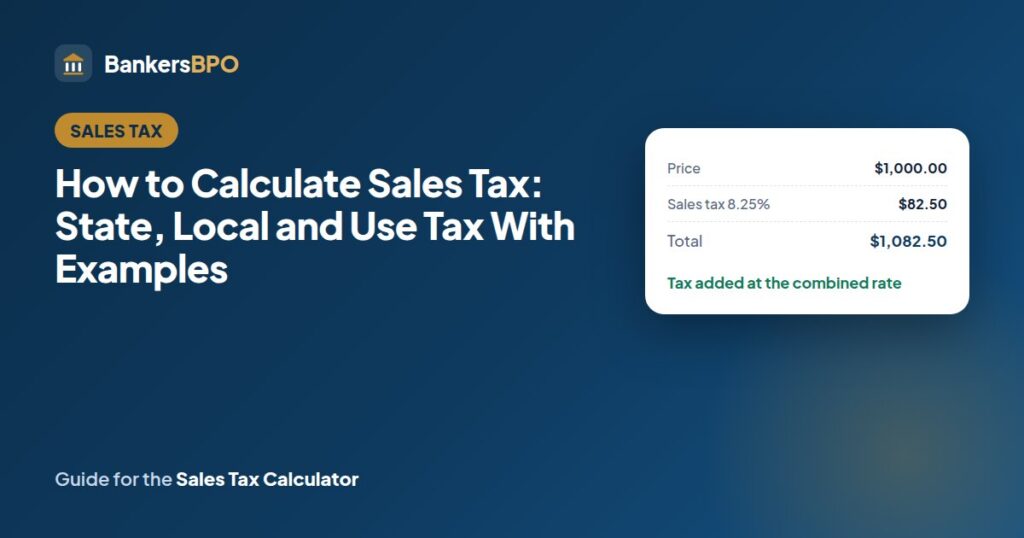
A $1,000 purchase at a combined rate of 8.25%: tax = 1,000 × 0.0825 = $82.50; total $1,082.50. A $49.99 item at the same rate: tax = $4.12 (4.124 rounded), total $54.11.
Rounding is to the nearest cent on the tax amount, with most states rounding half-cents up. Retailers compute the tax on the invoice total rather than line by line in most states, which can differ by a cent from adding up per-item tax; either is accepted as long as it is consistent.
Finding the combined rate
The rate is a stack: the state rate, plus county, city and special district rates that apply at the delivery address. Five states (Alaska, Delaware, Montana, New Hampshire, Oregon) have no state sales tax, though some Alaska localities charge their own. At the other end, combined rates above 10% exist in parts of Louisiana, Tennessee, Arkansas, Alabama and Washington once local add-ons are included.
The reliable source is the state department of revenue’s rate lookup, which takes an address or ZIP code and returns the combined rate. ZIP codes are not tax boundaries, so an address lookup is more accurate than a ZIP lookup; a ZIP can straddle two cities with different rates. Rate tables also change, usually on January 1, April 1, July 1 or October 1, so a rate from last year may be stale.
| Example location (illustrative) | State | Local | Combined |
|---|---|---|---|
| A city with no local tax | 6.00% | 0.00% | 6.00% |
| A city with county and city add-ons | 6.25% | 2.00% | 8.25% |
| A city with a transit district on top | 6.50% | 3.60% | 10.10% |
The sales tax calculator takes the combined rate directly. Enter the figure from the lookup, not the state rate alone.
What is taxable
Tangible goods are taxable almost everywhere. Beyond that, the states disagree. Groceries are exempt in most states, taxed at a reduced rate in some, and fully taxed in a few. Clothing is exempt in a handful of states, sometimes only below a dollar threshold. Prescription drugs are exempt nearly everywhere; over-the-counter drugs vary. Services are mostly untaxed in most states, but some tax repair, cleaning, digital products or software subscriptions. Restaurant meals are taxed, sometimes at a higher rate than goods.
Shipping charges are taxable in some states if the goods are taxable, and not in others. Discounts from the seller reduce the taxable price; manufacturer coupons usually do not, because the seller still receives the full amount.
For a purchase, the receipt settles it. For a business charging tax, the state’s taxability matrix is the reference, and the penalties for getting it wrong fall on the seller.
Who collects it, and where
Sales tax is destination-based in most states: the rate is the one at the address where the buyer receives the goods. A few states are origin-based for in-state sales, using the seller’s location. Since the 2018 Wayfair decision, online sellers with more than a threshold of sales into a state, commonly $100,000 or 200 transactions a year, must collect that state’s tax even with no physical presence there. Marketplace facilitators such as Amazon and Etsy collect on behalf of their sellers in every state with a sales tax.
The practical result for a shopper: the tax on an online order is the rate at your delivery address, whoever the seller is, and it should appear on the checkout page before you pay.
Use tax, the half nobody pays
When a seller does not collect sales tax on a taxable purchase, the buyer owes use tax at the same rate directly to the state. It applies to goods bought out of state and brought home, purchases from small out-of-state sellers under the collection threshold, and items a business buys tax-free for resale and then uses itself. Most state income tax returns have a line for it. Individual compliance is low; business compliance is audited, and use tax on equipment and supplies is a common audit finding.
Worked examples
A $2,400 laptop delivered to an address with a combined 8.25% rate: tax $198, total $2,598. The same laptop shipped to an Oregon address: no tax. Picked up in a store in the 6% city: $144.
A $150 restaurant bill in a city with a 10.1% combined rate and a 2% extra meals tax: tax = 150 × 0.121 = $18.15, total before tip $168.15. Tip on the pre-tax amount is the convention.
A $35,000 car bought in a state with a 6.25% vehicle rate and a $5,000 trade-in, where the state taxes the net price: tax = 30,000 × 0.0625 = $1,875. In a state that does not allow the trade-in credit, tax is on the full $35,000: $2,187.50. Vehicle rates and trade-in rules are set per state and often differ from the general rate.
A business invoice for $5,000 of taxable goods plus $200 of shipping in a state that taxes shipping on taxable sales, at 7%: tax = 5,200 × 0.07 = $364. The same invoice in a state that exempts separately stated shipping: tax = $350.
For businesses: registering and remitting
A business that sells taxable goods registers for a sales tax permit in each state where it has nexus, physical or economic, charges the destination rate on each sale, and files a return monthly, quarterly or annually depending on volume. The return reports gross sales, exempt sales and taxable sales by jurisdiction, and the tax due. Most states offer a small vendor discount for filing on time. Sales to resellers are exempt with a resale certificate on file; sales to tax-exempt organizations need their exemption certificate. The tax collected is held in trust for the state, and using it as working capital is the most common way small businesses end up with a tax lien.
Checking a receipt
Divide the tax line by the pre-tax subtotal. If the result is the combined rate for the store’s location (or your delivery address, for an order), the tax is right. If it is higher, a taxable item may have been exempt, a meals or lodging surcharge may apply, or the rate changed. If it is lower, some items were exempt, which the receipt usually marks. The sales tax calculator does the division when you enter the total and the rate in reverse mode; the guide on reverse sales tax calculation covers that in detail.
For a payment made with a check, the check amount in words tool writes the total including tax, and a vendor’s tax ID can be checked with the EIN validator before you set them up. All the tools are on the homepage.
FAQs
Do I pay sales tax on the price before or after a discount?
After a seller’s discount, since that is the price actually charged. Manufacturer coupons and rebates are different: in most states the tax is on the price before the coupon, because the seller is reimbursed by the manufacturer for the difference. Store loyalty discounts count as seller discounts.
Why is the sales tax different at two stores in the same city?
Special districts. A transit, stadium or improvement district can cover part of a city, so one store sits inside it and another a mile away does not. Address-level rate lookups catch this; ZIP-level ones often do not. It can also be a rate change that one store’s system has not applied yet, which is the store’s problem, not yours.
Is sales tax charged on services?
In most states, no, apart from specific listed services such as repairs, telecommunications, lodging or admissions. A few states, including Hawaii, New Mexico and South Dakota, tax most services. If a service invoice shows tax, the state probably lists that service as taxable; check the department of revenue’s taxability guide.
Can I deduct sales tax on my federal return?
If you itemize, you can deduct either state income tax or state sales tax, not both, within the overall state and local tax cap. The IRS provides a table estimate by income and state, plus actual tax on big purchases such as a car. It helps most in states with no income tax.
How often do rates change?
Local rates change several hundred times a year across the country, usually at the start of a calendar quarter after a local vote. State rates change rarely. Businesses subscribe to rate services or use their sales software’s updates; a shopper can just check the receipt or the state lookup.
What is a tax holiday?
A short period, often a weekend before the school year, when a state exempts certain items such as clothing under a price cap, school supplies or energy-efficient appliances. The exemption applies at checkout automatically. Online orders qualify if the order is placed during the holiday, in most states.