 English (India)
 Español
 Português
 Français
 Deutsch
 Italiano
 العربية
Most people write a few checks a year now, which is exactly why the words line causes trouble: there is no practice. This guide covers how to write a check amount in words the way banks expect, with the conventions for cents, hyphens, zero cents and large amounts, what to do with the leftover space, and which figure the bank uses when the words and the numbers disagree. The check amount in words tool produces the line for any amount; the rules below let you check it or write it yourself.
The standard form
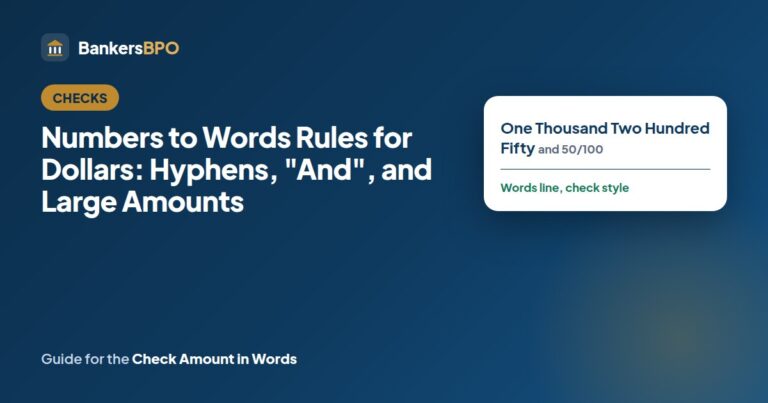
The amount $1,250.50 is written on the words line as:
One Thousand Two Hundred Fifty and 50/100
followed by the pre-printed “Dollars”. The dollars are in words, the cents are a fraction over 100, and “and” joins them. Capitalization is a matter of style; many people capitalize each word, and all lower case is equally valid. Hyphenate compound numbers from twenty-one to ninety-nine: Forty-Two, Ninety-Nine. Do not write “and” anywhere except before the cents, so $1,250 is “One Thousand Two Hundred Fifty”, not “One Thousand Two Hundred and Fifty”.
Cents
Always write the cents as a fraction, even when there are none: $75.00 is “Seventy-Five and 00/100” or “Seventy-Five and no/100”. Leaving the cents off invites someone to add them. Writing cents in words (“and fifty cents”) is understood by banks but is not the standard; the fraction is quicker to read and harder to alter.
For an amount under a dollar, write the cents and strike the word Dollars: “Only 75/100” with “Dollars” crossed out, or “Zero and 75/100”. Checks under a dollar are rare enough that either is accepted.
Large amounts
Group by thousands and millions, with no “and” between groups:
- $3,000: Three Thousand and 00/100
- $12,345.67: Twelve Thousand Three Hundred Forty-Five and 67/100
- $250,000: Two Hundred Fifty Thousand and 00/100
- $1,500,000: One Million Five Hundred Thousand and 00/100
Avoid writing “Twelve Hundred” for $1,200 on a check; it is understood in speech but “One Thousand Two Hundred” is the form that matches the digit grouping and leaves no room for argument. Spell out “Million” and “Thousand”; abbreviations such as “K” or “M” are not accepted.
Filling the line
Start at the far left of the line, write the amount, and draw a line through the remaining space to the word “Dollars”. The line stops anyone from inserting words. In the numeric box, write the figures close to the dollar sign for the same reason: “1,250.50”, not ” 1,250.50″ with room for a digit in front.
Use a pen, never pencil. If you make a mistake, write a new check rather than correcting the words line; a check with an altered amount may be refused, and a corrected one with initials is accepted by some banks and not others. Write “VOID” across the spoiled check and keep it for your records.
When the words and the figures do not match
Under the Uniform Commercial Code, which every state has adopted, the words control if they conflict with the figures. A check with “One Thousand Two Hundred Fifty and 50/100” on the words line and “1,520.50” in the box is a check for $1,250.50. In practice banks often return a check with a mismatch rather than pay the words amount, because the mismatch is a sign of alteration or error, and the payee is left to ask for a new one. Writing the two to match is the only outcome without a delay.
If the words are illegible or missing, the figures are used. A check with figures only is technically incomplete, and a bank may pay it or not at its discretion.
Common mistakes
Writing “and” between hundreds and tens (“Two Hundred and Fifty”). Harmless to a bank, but it is the one place where “and” means the decimal point on a check, and the tool omits it for that reason.
Mixing numerals into the words line (“1 Thousand 250 and 50/100”). Many banks accept it; it defeats the purpose of the line, which is to be hard to alter.
Omitting the cents fraction on a round amount. Add “and 00/100”.
Writing the cents as “50/100 Cents”. The pre-printed word is Dollars, so the fraction is of a dollar.
Spelling errors in Forty (not Fourty) and Ninety (not Ninty), which are common enough that tellers see them weekly. Neither causes a check to bounce, but they look careless on a rent check.
Worked examples
| Figures | Words line |
|---|---|
| $8.00 | Eight and 00/100 |
| $20.25 | Twenty and 25/100 |
| $99.99 | Ninety-Nine and 99/100 |
| $450.00 | Four Hundred Fifty and 00/100 |
| $1,250.50 | One Thousand Two Hundred Fifty and 50/100 |
| $2,000.05 | Two Thousand and 05/100 |
| $17,340.00 | Seventeen Thousand Three Hundred Forty and 00/100 |
| $125,000.00 | One Hundred Twenty-Five Thousand and 00/100 |
Two rows deserve a second look. $2,000.05 has five cents, written “05/100” with the leading zero so that nothing can be squeezed in front of the 5. And $99.99 shows the hyphen rule twice: once in the dollars and once in the cents fraction, where the cents are digits and need no hyphen at all.
The other fields, briefly
The words line is one of five things a check needs: the date, the payee, the figures, the words and the signature. Write the payee’s full name as it appears on their account, since a check to “Bob” cannot be deposited by Robert Smith at some banks. The date can be today’s; post-dating a check does not stop the bank paying it early. The memo line is optional and is for your records (an invoice number, “March rent”); it has no legal effect. Sign in the same way as the signature card on file, or the bank may hold the check. Keep the carbon or write the details in the register; a check you cannot identify three months later is a check you cannot dispute with the bank.
Electronic checks and online bill pay
When a bank prints a check for you through online bill pay, it fills the words line itself from the amount you enter, in the standard form. The same is true of payroll and accounts payable software. The words line still matters because the printed check is the legal instrument, so if a vendor says the check amount is wrong, the printed words settle it.
Using the tool
Type the amount into the check amount in words tool and copy the result onto the line. The default output is the “and 50/100” form; the plain-words option writes the cents in words for letters or contracts where a fraction looks odd. For the figures box, the amount including any sales tax can be checked in the sales tax calculator, and the routing number printed on the bottom of the check can be verified with the routing number validator if you are setting up a payment from it. All the tools are on the homepage.
FAQs
Do I have to write “Dollars” after the amount?
No; it is pre-printed at the end of the line. Your words end with the cents fraction and the line you draw to fill the space. If the check stock has no pre-printed “Dollars”, write it yourself after the fraction.
Can I write the amount in all capitals?
Yes. Capitals, title case and lower case are all accepted. Some payroll systems print the words line in capitals for legibility. The tool has a copy-in-capitals option for that. What matters is that the words are complete, legible and match the figures.
How do I write a check for an amount with no dollars, such as 50 cents?
Write “Only 50/100” or “Zero and 50/100” on the words line and strike through “Dollars”, and write “0.50” in the box. Some people write “Fifty cents only” and cross out Dollars; banks accept it. Checks this small are usually not worth the postage, which is why the form is unfamiliar.
Is a check valid if I write “One Thousand Two Hundred and Fifty”?
Yes. Banks read it as $1,250 and the extra “and” is ignored. The convention of omitting it exists to keep “and” as the marker for the cents, but no bank bounces a check over it, and tellers see it every day.
What if the check is for a foreign currency?
US checks are in dollars; a check drawn on a US bank in another currency is unusual and may not be accepted. For a foreign payee, banks offer foreign drafts or wire transfers instead. The words line on a foreign draft is filled by the bank in that currency’s form.
Does the words rule apply to money orders and cashier’s checks?
Cashier’s checks and money orders are filled in by the bank or issuer, including the words line, so you do not write it. Check that the printed words match the amount you paid before you hand it over; errors are rare but are easier to fix at the counter than later.