 English (India)
 Español
 Português
 Français
 Deutsch
 Italiano
 العربية
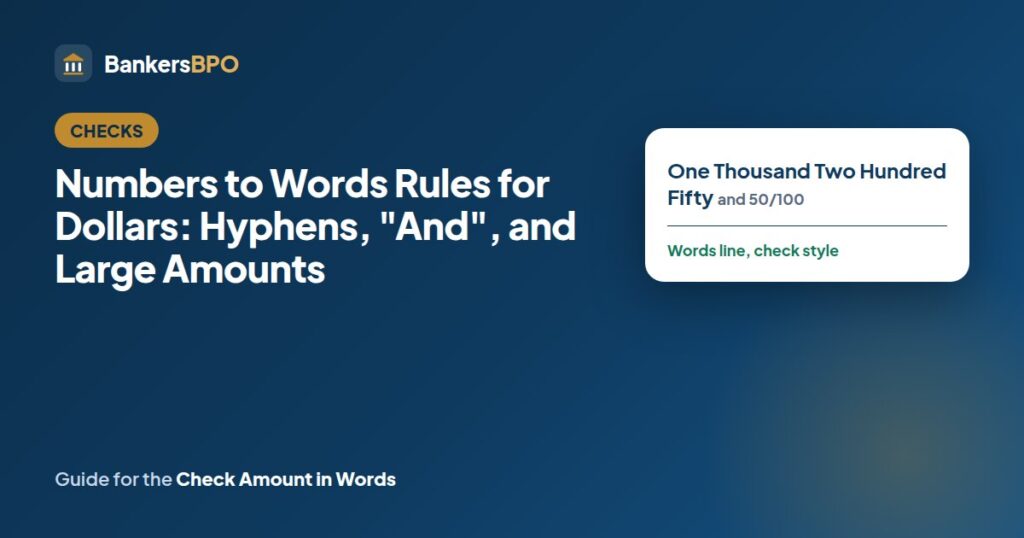
Writing a dollar amount in words comes up on checks, contracts, invoices, promissory notes and court filings, and each has a slightly different convention. The numbers to words rules for dollars below are the ones US banks, lawyers and accounting software agree on, with the variations noted where they exist. The check amount in words tool applies them automatically; this guide is for writing by hand or checking what the software produced.
The building blocks
Zero to nineteen have their own words. Twenty to ninety are the tens. Everything from twenty-one to ninety-nine is a ten plus a unit, joined by a hyphen: twenty-one, forty-two, ninety-nine. Hundreds are a unit word plus “hundred”, with no hyphen: three hundred, nine hundred. Thousands, millions and billions follow the same pattern with the group word.
| Figure | Words |
|---|---|
| 7 | Seven |
| 15 | Fifteen |
| 40 | Forty |
| 42 | Forty-Two |
| 100 | One Hundred |
| 115 | One Hundred Fifteen |
| 342 | Three Hundred Forty-Two |
| 1,000 | One Thousand |
| 1,042 | One Thousand Forty-Two |
| 12,345 | Twelve Thousand Three Hundred Forty-Five |
| 250,000 | Two Hundred Fifty Thousand |
| 1,500,000 | One Million Five Hundred Thousand |
| 2,000,000,000 | Two Billion |
Spellings that are often wrong: Forty (no u), Ninety (not Ninty), Fourteen (with the u), Nineteen. Twelve, not Twelf.
The hyphen rule
Hyphenate only the compound numbers from twenty-one to ninety-nine, including when they appear inside a larger number: Three Hundred Forty-Two, Twelve Thousand Three Hundred Forty-Five. Do not hyphenate between a unit and “hundred” or “thousand” (Three Hundred, not Three-Hundred), and do not hyphenate across groups (One Thousand Forty-Two has one hyphen).
Style guides for prose sometimes hyphenate more, as in “three-hundred-page book”, but that is an adjective rule and does not apply to amounts.
Where “and” goes
In American usage, “and” is not used inside a whole number. Two hundred fifty, not two hundred and fifty. One thousand forty-two, not one thousand and forty-two. British usage puts “and” after the hundreds, and many Americans say it in speech, but on US financial documents the convention is to omit it.
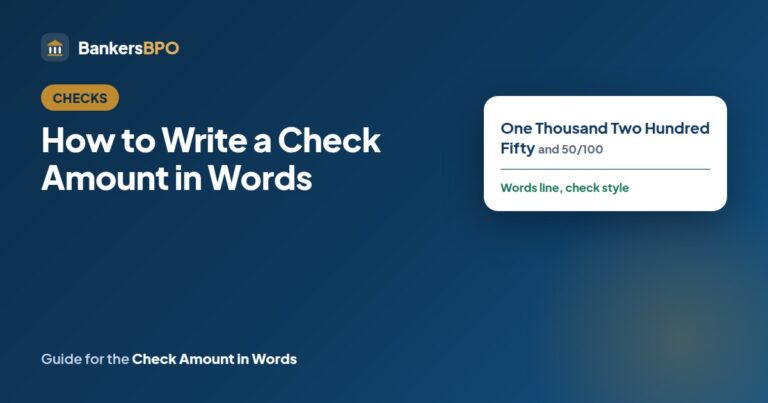
The one place “and” belongs is between the dollars and the cents: One Thousand Two Hundred Fifty and 50/100. On a check the cents are a fraction; in a contract they may be spelled out: “one thousand two hundred fifty dollars and fifty cents”. Keeping “and” for the decimal point is what makes the words line unambiguous.
Zero cents
On a check: “and 00/100” or “and no/100”, always present. In a contract: “five thousand dollars and no cents” or simply “five thousand dollars ($5,000.00)”, where the figures carry the cents. Leaving the cents unstated on a check is an invitation to add them; in a contract it is merely sloppy.
Large amounts and the group words
Group the figure in threes from the right and name each group: 12,345,678 is twelve million, three hundred forty-five thousand, six hundred seventy-eight. Say each group’s hundreds-tens-units, then its group word, and move on. A group of zeros is skipped entirely: 1,000,042 is One Million Forty-Two.
Use “One Thousand Two Hundred”, not “Twelve Hundred”, in writing. The spoken form is fine but on a document it should match the digit grouping. “A Thousand” and “A Hundred” are also spoken forms; write “One”.
American billion is a thousand million (1,000,000,000), and trillion is a thousand billion. Older British usage had a billion as a million million; US documents never use that sense.
Legal documents and the figures in parentheses
Contracts, promissory notes and wills usually write the amount in words followed by the figures in parentheses: “the sum of Twenty-Five Thousand Dollars ($25,000.00)”. The convention is older than typewriters and exists to catch transcription errors; if the two differ, courts generally follow the words, the same rule as on checks. Modern drafting guides suggest dropping the duplication because it creates the possibility of conflict, but most firms still use it.
Capitalization in legal documents varies: Title Case, ALL CAPITALS and lower case are all seen. Consistency within the document matters more than the choice.
Negative amounts, ranges and approximations
Negative amounts are not written in words on financial instruments; a refund is a positive amount on a document that says it is a refund. Ranges (“between five and ten thousand dollars”) and approximations (“about two million”) belong in prose, not on a payment line, where a single exact amount is required.
Three conversions, step by step
$4,071.08. Split into groups: 4 | 071. Thousands group: Four Thousand. Units group: seventy-one, hyphenated. Cents: 08/100 with the leading zero. Result: Four Thousand Seventy-One and 08/100.
$310,500.00. Groups: 310 | 500. Three Hundred Ten Thousand, then Five Hundred, then and 00/100. There is no “and” between the groups and no hyphen in Three Hundred Ten.
$1,000,900.50. Groups: 1 | 000 | 900. One Million, skip the empty thousands group, Nine Hundred, and 50/100: One Million Nine Hundred and 50/100. The skipped group is the step most people get wrong, either by writing “One Million Zero Thousand” or by losing track and writing Nine Thousand.
Checks, contracts and invoices
On a check the words line is required and the cents go as a fraction. In a contract the words are a convention, usually with figures in parentheses, and the cents are spelled out or carried by the figures. On an invoice the words are optional and rare in the US; the figures govern. On a promissory note the words are expected and the parentheses form is standard. Court filings and settlement agreements follow the contract form. If a document template already has a words field, fill it in the form the template implies; if it does not, figures alone are acceptable everywhere except a check. When in doubt, use the check form with the fraction for cents: it is the most widely recognized, the hardest to alter, and no reader will object to seeing it on a contract. The reverse, a fraction-free contract form on a check, leaves the cents open to question, which is the one thing the words line exists to prevent in the first place.
Errors the tool is built to avoid
Dropping a group: writing One Million Forty-Two for 1,040,002 (which is One Million Forty Thousand Two). The tool names each non-zero group in order.
Hyphenating the wrong things: Forty-Two Thousand (correct) versus Forty-Two-Thousand (wrong).
“And” inside the number, which the tool omits.
Cents as a decimal in words: “and point five” is never correct; it is “and 50/100” or “and fifty cents”.
Rounding the cents: $19.995 does not exist on a check; round to the cent before writing.
Using the tool
Enter the figure in the check amount in words tool. The check-style output gives “and 50/100 Dollars”; the plain-words option writes the cents in words for contracts and letters. Copy in capitals for forms that require it. For the figure itself, the sales tax calculator produces a tax-inclusive total to the cent, and the loan payment calculator gives a payment amount that may need writing out on a payoff check. All the tools are on the homepage.
FAQs
Is it “One Hundred” or “A Hundred” on a check?
“One Hundred”. “A hundred” is spoken English, and while a bank would understand it, the words line is meant to match the figures, which show a 1. The same applies to “a thousand” and “a million”; write the One in every case.
Should I write “Dollars” at the end in a contract?
Yes, in a contract or letter, because there is no pre-printed word: “Twenty-Five Thousand Dollars ($25,000.00)”. On a check the word is already printed at the end of the line, so you stop at the cents fraction and draw the line.
How do I write an amount over a billion?
Name each group of three from the left: 2,500,000,000 is Two Billion Five Hundred Million. Amounts this size appear in bond documents and settlements rather than checks, and they follow the same rules; the tool handles figures up to the trillions.
Are commas used in the words?
Optional in prose, usually omitted on a check or a payment line, where the words run together with spaces and the hyphens do the work. In a long legal amount some drafters add commas after each group word for readability; it does not change the meaning.
Does Canadian or British usage differ?
British and Canadian writers often include “and” after hundreds (“two hundred and fifty”) and British cheques traditionally wrote cents as “pence” and the amount with “only” at the end. US documents omit the internal “and” and use the fraction form for cents. If a document crosses borders, the figures in parentheses settle any doubt.
What about writing “Only” after the amount?
Some people add “Only” after the cents fraction to stop additions, a habit from countries where it is standard. US banks accept it and ignore it. Drawing a line through the unused space does the same job and is the American convention.